The Ultimate Checklist: Avoiding Common Embroidery Mistakes for Flawless Designs
Imagine the frustration of watching a needle tear through a premium polo shirt because the stitch density was set too high for the delicate knit. It’s a heart-sinking moment that turns an expensive garment into a scrap piece in seconds. You want your brand to radiate quality, yet achieving that crisp, professional look often feels like a technical hurdle rather than a creative joy. We understand that every stitch carries the weight of your reputation, and avoiding common embroidery mistakes is the vital first step toward consistent excellence.
You deserve to feel confident every time the machine starts, knowing your fabric and thread are in perfect harmony. This article promises to help you master the art of precision embroidery by teaching you how to sidestep the most frequent pitfalls in digitizing and machine setup. We’ll explore the essential checklist for flawless designs, from selecting the right stabilizers to understanding why professional digitizing is a non-negotiable investment for your brand’s legacy. Let’s transform your creative vision into a tangible masterpiece that lasts.
Key Takeaways
- Master the transition from digital art to physical thread by understanding why professional digitizing is critical for maintaining logo integrity and precision.
- Eliminate unsightly puckering by learning the “Golden Rule” of matching specific cut-away or tear-away stabilizers to your chosen fabric type.
- Safeguard your project by avoiding common embroidery mistakes like bird-nesting through precise tension adjustments and proper needle sizing for different garment weights.
- Use our comprehensive pre-stitch checklist to verify design dimensions and stitch density, ensuring a flawless finish on everything from custom hats to personalized blankets.
- Discover how partnering with a boutique specialist ensures your custom apparel serves as a high-quality vessel for your unique personal or professional story.
The Foundation: Avoiding Digitizing and Artwork Errors
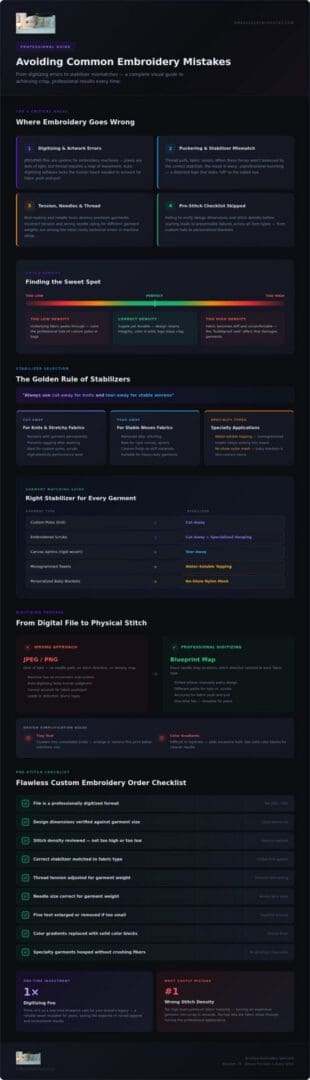
Many clients are surprised to learn that a high-resolution JPEG or PNG file, while perfect for a website, is virtually useless for an embroidery machine. Pixels are just dots of light, but thread requires a map of movement. Avoiding common embroidery mistakes often begins with this realization. Without a proper conversion, your design won’t have the depth or clarity it deserves, and you risk damaging the very garments you’re trying to enhance.
Digitizing acts as the technical bridge between digital art and physical craftsmanship. This process determines exactly where each needle drop occurs. If the stitch density is too high, the fabric becomes stiff and uncomfortable, often referred to as a “bulletproof vest” effect. Conversely, low density allows the underlying fabric to peek through, ruining the professional look of your custom polos or bags. A deep knowledge of embroidery techniques and materials ensures that your design remains supple yet durable. Mastering these technical nuances is the secret to avoiding common embroidery mistakes that compromise the quality of your finished product.
The One-Time Logo Digitizing Fee Explained
Think of the digitizing fee as a one-time blueprint cost for your brand’s legacy. While “auto-digitizing” software exists, it lacks the human touch needed to account for fabric push and pull. A skilled artisan manually paths the design, adjusting the stitch direction differently for structured hats than for soft knit scrubs. This meticulous planning prevents the distortion that often plagues cheap, factory-made alternatives. Once your logo is digitized correctly, it’s a reliable asset you can use for years, saving you from the expense of ruined apparel and inconsistent results.
Simplifying Designs for Better Thread Translation
Thread has physical limitations that digital ink does not. Tiny text often clusters into unreadable knots; it’s usually best to enlarge or remove fine print that falls below a certain size. Similarly, while color gradients look stunning on a monitor, they are difficult to replicate with thread without adding excessive bulk to the garment. Solid blocks of color provide a much cleaner, more sophisticated finish. Simplifying these elements ensures your logo remains crisp and professional across every item in your order, from custom aprons to personalized baby blankets.
The Pucker Problem: Matching Fabric to Stabilizer
Thread pulls. Fabric resists. When these two forces aren’t balanced by the correct stabilizer, the result is a wavy, unprofessional mess. This unsightly bunching, known as puckering, is one of the most frequent issues in custom work. Avoiding common embroidery mistakes in this area requires a deep respect for the physics of the stitch. If the backing is too light for the design’s density, the garment will inevitably shift during high-speed machine runs, leaving you with a distorted logo that looks “off” to the naked eye.
The secret to a flat, crisp finish lies in the “Golden Rule” of stabilizers: always use cut-away for knits and tear-away for stable wovens. Cut-away backings remain with the garment for its entire life, providing the permanent support needed for stretchy materials. Without it, even the most beautiful logo will eventually sag or pucker after a few trips through the laundry. For Houston businesses that value longevity, choosing a partner like Embroidery By Shotzy ensures that these technical pairings are handled with artisan precision.
Choosing the Right Garment for Your Design
Not every garment is a suitable canvas for every design. Custom polos, with their flexible knit structure, require a much more robust stabilizer than heavy-duty custom aprons made of rigid canvas. Performance wear and embroidered scrubs present a unique hurdle due to their high elasticity and moisture-wicking properties. To prevent “ghosting” or permanent ring marks, we employ specialized hooping techniques that secure the fabric without crushing the delicate fibers. This careful handling preserves the integrity of the garment while ensuring the embroidery remains perfectly centered and flat.
Stabilizer Types and Their Best Uses
Selecting the right foundation is a nuanced craft. While cut-away and tear-away are the workhorses of the industry, certain projects demand more specialized solutions. When creating monogrammed towels, a water-soluble topping is essential to prevent stitches from sinking into the high-pile loops. For items that require a soft touch against the skin, such as personalized baby blankets, “no-show” nylon mesh provides invisible strength without the bulk or stiffness of traditional backings. By matching the weight and type of stabilizer to both the fabric and the stitch count, you ensure a professional result that stands the test of time.
Technical Tuning: Tension, Needles, and Thread Quality
Precision in embroidery is a delicate dance between a machine’s mechanics and the artisan’s intuition. While digitizing provides the map, the physical execution relies entirely on technical tuning. Avoiding common embroidery mistakes often comes down to the small, unseen adjustments made before the first stitch is cast. A poorly calibrated machine can turn a premium garment into a tangled mess of bird-nesting thread in seconds. We treat our equipment like fine instruments, ensuring that every needle drop is purposeful and every thread path is clear.
Thread quality is just as vital as the machine’s settings. We’ve seen how cheap, bargain threads can fail under pressure. They are often brittle, leading to frequent breaks that disrupt the flow of a design. More importantly, low-quality threads lose their vibrancy after just a few washes, which reflects poorly on your brand’s image. By choosing high-luster, durable threads and committing to regular machine calibration, we maintain a standard of excellence that honors the personal significance of your project. Mastering these technical details is the hallmark of a professional who values the lasting impact of quality craftsmanship.
Thread Tension: The Invisible Success Factor
Correct tension is what keeps a design looking crisp and professional. If the top tension is too loose, you’ll notice unsightly looping on the surface of your custom patches or hats. We use the bobbin test to ensure the underside of the garment is as clean as the top; ideally, you should see a perfect balance of bobbin and top thread. When handling bulk orders at high speeds, these settings must be monitored constantly. Even a slight shift in humidity or thread weight can require a quick recalibration to prevent the design from distorting. Avoiding common embroidery mistakes during these high-volume runs requires a vigilant eye and a commitment to perfection.
Needle Knowledge for Custom Apparel
- Ballpoint needles are essential for knits like custom polos and personalized baby blankets. They slide between fibers rather than cutting them, preventing permanent holes in the fabric.
- Sharp needles are the preferred choice for structured items like woven hats or heavy-duty bags, where the needle must pierce through dense material with absolute precision.
- Frequent changes are mandatory for high-quality results. We change needles far sooner than most expect, typically every eight hours of run time, to ensure the tip remains sharp and burr-free.
One often overlooked factor is needle heat. During high-speed runs on synthetic performance wear or embroidered scrubs, a hot needle can actually melt polyester fibers. This creates permanent damage that no amount of cleaning can fix. By slowing down the machine for delicate synthetics and using the correct needle size, we protect the integrity of your garment while delivering a flawless, high-impact finish.
A Checklist for Flawless Custom Embroidery Orders
Achieving a flawless finish is a collaborative journey that begins long before the machine starts humming. While technical settings are vital, the planning phase is where the most impactful decisions are made. A comprehensive checklist serves as your final safeguard, ensuring that your creative vision translates perfectly onto the chosen material. Avoiding common embroidery mistakes often requires a simple pause to validate dimensions and garment compatibility. For instance, a dense, heavy design might look stunning on a canvas bag but will cause a lightweight performance polo to sag and lose its shape.
Communication is the bridge between a digital concept and a physical masterpiece. It’s essential to share the intended end-use of your items with your embroiderer. Uniforms for a high-traffic restaurant require different considerations than a personalized baby blanket intended for a nursery. By discussing these details upfront, you allow the artisan to select the most durable threads and appropriate backings for the job. This proactive approach eliminates surprises and ensures the final product meets your expectations for both beauty and longevity.
Pre-Order Verification Steps
Before finalizing your order, take a moment to verify the specifics. For corporate branding, provide specific PMS codes to ensure your thread colors match your official identity perfectly. We also recommend the “three-finger rule” for polo placement; this typically aligns the logo with the second button for a balanced, professional appearance. Having high-resolution artwork ready ensures the digitizing process starts with a clear, sharp foundation. This attention to detail is a vital part of avoiding common embroidery mistakes that can lead to costly reprints or wasted garments.
Communicating with Your Embroidery Partner
When you work with a boutique artisan, clear communication is the key to success. Don’t hesitate to ask for a “sew-out” on scrap fabric. This physical proof allows you to see how the thread interacts with the material and catches any potential spelling errors in monograms before we move to bulk production. Our local Houston expertise also helps in selecting fabrics that withstand the Texas humidity while maintaining their structure. If you’re ready to bring your vision to life with meticulous care and professional precision, start your custom embroidery project today and experience the difference that craftsmanship makes.
The Shotzy Difference: Precision in Every Stitch
Choosing a partner for your branding is about more than just finding a machine. It’s about finding a steward for your story. Since 2014, Embroidery By Shotzy has served as a boutique Houston specialist where meticulousness is the standard, not an upgrade. We believe physical items serve as vessels for professional legacies. This philosophy drives our commitment to technical precision, ensuring that every custom patch or embroidered hat we produce meets the highest level of craftsmanship. It’s this deep investment in the final result that builds lasting trust with our corporate clients and individual gift-seekers alike.
The greatest advantage of working with a local artisan over a mass-production factory is the personal investment in your success. High-volume facilities often prioritize speed over quality, which is where most errors occur. Avoiding common embroidery mistakes requires a steady, purposeful rhythm that only a dedicated expert can provide. We don’t just “run” your files; we analyze them. This means ensuring the stitch count is accurate and the tension is perfectly tuned for your specific garment choice before the machine ever starts. You won’t have to worry about distorted logos or ruined apparel when you have a master of the craft overseeing every needle drop.
Boutique Quality for Houston Businesses
Our process transforms your simple JPEG into a masterpiece of manual pathing. We treat a single personalized baby blanket with the same reverence as a fleet of corporate custom polos or embroidered scrubs. This attention to detail prevents the distortion and “bleeding” common in automated work. By supporting local craftsmanship, you aren’t just getting a product; you’re strengthening the Houston economy and ensuring your brand is represented by a team that understands local needs. We take pride in being a creative partner that guides you through every technical hurdle, from choosing the right thread for custom aprons to selecting durable backings for embroidered bags.
Ready to Transform Your Vision?
Collaborating with us is a seamless experience designed to put you at ease. Our skilled team is ready to guide you through the nuances of fabric and thread selection, ensuring your vision is brought to life exactly as you imagined. We understand that the value of professional digitizing is a safeguard for your reputation and your budget. We invite you to bring your ideas to us, and together, we will turn them into a physical reality that reflects your commitment to excellence. Whether you need monogrammed towels for a boutique hotel or personalized headwear for a local team, we handle every stitch with the care it deserves.
Start your custom embroidery project with Shotzy today!
Elevate Your Brand with Precision Craftsmanship
Mastering the technical bridge of digitizing and the science of stabilizer selection transforms a simple design into a professional legacy. Understanding that precision is a marriage of technical tuning and quality materials ensures your garments remain as vibrant and durable as your vision. By focusing on these foundational steps, you’re well on your way to avoiding common embroidery mistakes that compromise quality. A little preparation goes a long way in preserving the integrity of your brand’s image.
Since 2014, we’ve provided over 10 years of Houston-based craftsmanship to help local brands and individuals stand out. We specialize in complex corporate digitizing and use only the finest threads and stabilizers to protect every stitch. Whether you’re creating custom hats or personalized baby blankets, we bring a boutique level of care to every project. Ready to see your vision in thread? Request a Custom Embroidery Quote from Shotzy today. Your story deserves to be told with excellence, and we’re here to help you stitch every detail to perfection.
Frequently Asked Questions
How do I prevent my embroidery from puckering?
You prevent puckering by matching the stabilizer weight to your fabric’s density and ensuring proper hooping tension. Puckering often occurs when stretchy fabrics like performance polos aren’t supported by a cut-away stabilizer during high-speed stitching. In Houston’s humid climate, fibers can expand, so we use precise hooping techniques to keep the garment flat. Avoiding common embroidery mistakes like using a stabilizer that’s too light will keep your designs looking crisp.
Why does my embroidery have gaps between the stitches?
Gaps usually indicate insufficient stitch density or a lack of proper underlay stitches in your digitizing file. When the fabric isn’t anchored correctly, the top stitches can’t bridge the distance, leaving the underlying material visible. This is common when attempting to embroider a large logo on a structured hat without adjusting for the curve. Professional digitizing accounts for “push and pull” to ensure every gap is filled with precision thread paths.
Can I embroider any logo I have on my computer?
No, you cannot directly embroider a standard image file like a JPEG or PNG because machines require a specific path-based file. Each design must undergo a technical process called digitizing to translate pixels into needle drops. We take your digital artwork and manually path each stitch to ensure it works on specific items, such as custom patches or corporate uniforms. This conversion is the foundation of high-quality, professional results.
What is the most common mistake beginners make in machine embroidery?
The most frequent error is choosing the wrong stabilizer for the garment type. Beginners often use tear-away on knits, which leads to sagging and distortion after the first wash. Another common pitfall is improper hooping, where the fabric is either too loose or over-stretched. At our Houston boutique, we emphasize that technical precision starts with these basic setup steps to ensure your creative vision translates perfectly into a physical masterpiece.
Why is my embroidery thread constantly breaking?
Constant thread breaks typically stem from improper tension, a burred needle, or using low-quality thread that lacks durability. If your top tension is too tight, the thread will snap under the machine’s speed. We recommend changing needles every eight hours of run time to maintain a sharp point. Using premium, high-luster threads prevents these interruptions and ensures your custom polos and bags retain their excellence over time.
How do I choose the right stabilizer for my project?
You choose a stabilizer based on the stability and stretch of your fabric. The general rule is to use cut-away for any material with stretch, like custom scrubs or baby blankets, and tear-away for stable, woven items like aprons. For high-pile fabrics like monogrammed towels, we add a water-soluble topping to keep stitches from sinking. This methodical approach ensures your embroidery stays flat and beautiful for the life of the garment.
What is digitizing, and why do I need to pay for it?
Digitizing is the technical bridge between your digital art and the physical embroidery machine. It’s a skilled service where an artisan maps out every stitch, direction, and density setting. You pay for this expertise because it’s the only way to ensure your logo looks crisp on different materials, from hats to polos. At Embroidery By Shotzy, we treat this as a one-time investment in your brand’s long-term quality and consistency.
How do I fix “bird-nesting” under my embroidery hoop?
You fix bird-nesting by completely re-threading both the top thread and the bobbin while ensuring the presser foot is up during the process. This tangle of thread under the hoop usually happens when the top thread isn’t seated correctly in the tension disks. Clean your bobbin case regularly to remove lint, especially when working on high-volume orders in Houston. Proper machine maintenance is essential for avoiding common embroidery mistakes and maintaining a smooth workflow.