The Best File Format for Embroidery Digitizing: A 2026 Guide to Perfect Stitches
The highest resolution image on your computer screen might actually be the worst choice for your brand’s legacy. You might think that high-resolution JPEG you spent hours perfecting is the key to a crisp logo on your custom polos, but it’s often the very thing causing your embroidery to look blurry or distorted. Finding the best file format for embroidery digitizing isn’t just about image quality. It’s about how we translate a digital vision into a physical masterpiece of thread and texture.
It’s incredibly frustrating to invest in a design only to receive a finished product that lacks the professional edge you expected. We understand the fear of paying a second digitizing fee just because the initial file wasn’t quite right for the machines. This guide will demystify the technical side of our craft, showing you exactly which files to provide so your vision translates perfectly onto every custom hat or patch. We’ll explore the crucial difference between artwork files and stitch files, while explaining why certain formats are the gold standard for 2026. By the end, you’ll know how to save time and ensure your logo looks flawless from the very first stitch.
Key Takeaways
- Understand why vector files like AI or EPS are the essential starting point for translating a digital design into high-quality thread-work.
- Learn why the best file format for embroidery digitizing involves a transition from your source artwork to machine-ready DST files used by commercial professionals.
- Discover how technical factors like stitch density and pull compensation ensure your logo looks crisp and professional on everything from hats to polos.
- See why professional digitizing is a valuable one-time investment that provides you with a master file for all your future branding projects.
- Gain the confidence to provide the right file types first, saving you time and preventing the frustration of unexpected digitizing fees.
The Foundation of Precision: Why File Formats Matter in 2026
Precision in custom apparel begins long before the first needle drops. It starts with a digital translation that bridge the gap between a graphic designer’s screen and the physical texture of thread. Embroidery digitizing is the meticulous art of converting a flat image into a complex map of thread paths. Unlike a printer that simply sprays ink, the computerized machine embroidery process requires specific instructions for every single movement of the needle. A standard image file like a JPEG or PNG contains pixels, but it doesn’t tell a machine where to start, which direction to pull, or how much tension to apply. Without the best file format for embroidery digitizing, you risk common technical failures like thread breaks or needle deflection, which can ruin a high-quality garment and waste valuable time.
The relationship between file precision and the longevity of your custom apparel is direct. A poorly digitized file creates a stiff, uncomfortable design that may pucker or unravel after a few washes. By contrast, a professionally prepared file ensures the design moves with the fabric, maintaining its integrity for years. This technical foresight is what prevents the “thread mess” often seen in low-budget work, ensuring your brand’s legacy is represented with excellence on every custom polo or bag.
The Difference Between Artwork and Stitch Files
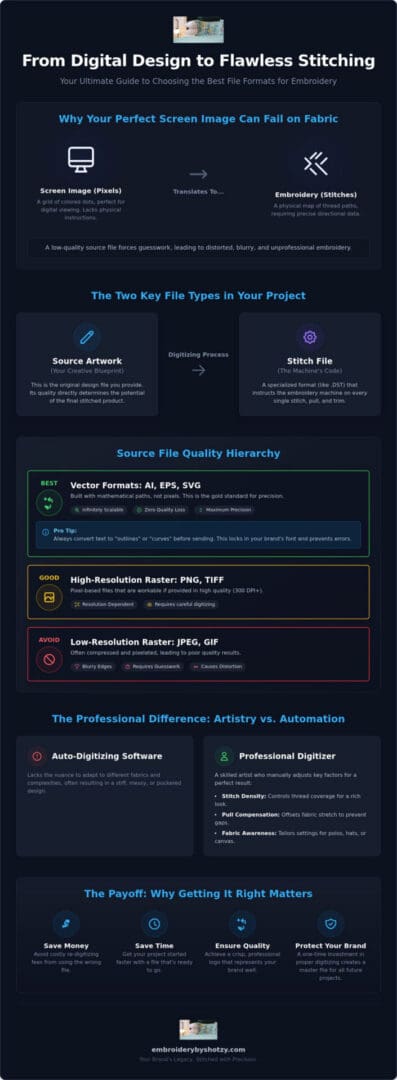
It helps to think of your files in two distinct categories. Your source files, such as AI, EPS, or high-resolution PDFs, serve as the creative blueprint. These are the “best” files to send to a professional because they allow for infinite scaling without any loss of detail. However, the embroidery machine cannot read these directly. It requires a machine-ready “stitch file,” most commonly a DST or PES. For any successful Houston embroidery project, having access to the original source artwork is essential for creating the most accurate technical instructions for the machine.
The Role of the Digitizer as a Creative Partner
While “auto-digitizing” software has become more common, it often lacks the nuance required for professional results. A computer program doesn’t understand how thread interacts with a heavy canvas hat versus a soft pique polo. At Embroidery By Shotzy, we treat every logo as a unique narrative. We manually adjust for pull compensation and stitch density to ensure the longevity of your brand’s image. This human element is what transforms a simple digital file into a physical masterpiece. Choosing the best file format for embroidery digitizing is the first step in this collaborative journey, allowing us to focus on the craftsmanship that makes your custom patches or blankets truly unique.
Source Artwork: The Best Formats to Send Your Digitizer
Your source artwork is the creative DNA of your finished design. While we can work with many different types of imagery, the quality of the file you provide directly dictates the level of detail we can achieve. Selecting the best file format for embroidery digitizing begins at the design stage; providing a high-quality original ensures that every curve of your logo is captured with absolute fidelity. When we receive a clean, crisp file, we can focus our energy on the artistry of the thread rather than trying to reconstruct blurry edges.
The hierarchy of files generally places vector graphics at the pinnacle of excellence. These files are the best formats to send your digitizer because they are built on mathematical paths rather than a grid of colored pixels. If a vector isn’t available, a high-resolution raster file is a workable alternative, but low-resolution JPEGs often lead to distortion because the digitizer has to guess where one color ends and another begins.
Vector Formats: AI, EPS, and SVG
Vector files are the gold standard for a reason. Because they rely on geometry, they allow for infinite scaling without any loss of clarity. This is particularly vital for projects like custom patches, where tiny text or intricate borders require surgical precision. Before you send your AI or EPS file, always remember to convert your text to “outlines” or “curves.” This ensures that your specific brand fonts stay intact, even if we don’t have that exact typeface installed on our systems. It’s a small step that protects the unique identity of your brand and ensures your vision is preserved.
Raster Formats: High-Resolution PNG and TIFF
If you’re working with a photograph or a design created in a raster-based program, resolution is your most important metric. We consider 300 DPI (dots per inch) the magic number for successful conversion. Anything lower often results in pixelation that makes it impossible to define sharp edges. When exporting from tools like Canva, always choose the highest quality setting and ensure your background is truly transparent. A “faux” white background can sometimes hide stray pixels that interfere with the meticulous digitizing process we use to create your custom hats or polos.
Whether you are exporting from Adobe or a web-based design tool, always check for “anti-aliasing” issues. These are the soft, semi-transparent pixels that appear on the edges of shapes. In the world of thread, there is no “semi-transparent” color; there is only thread or no thread. Providing a clean, high-contrast file allows us to translate your vision into a physical masterpiece that looks exactly as you intended.
Deciphering the Machine Code: Common Embroidery Output Formats
Once your artwork is finalized, it must be translated into a language that high-speed industrial machines can understand. This is where the digital design transforms into a set of coordinate instructions. While vectors are the best starting point, the best file format for embroidery digitizing in its final, machine-ready state is usually a DST file. These files act as the bridge between your vision and the physical garment, containing every jump, trim, and stitch command required to bring your logo to life on custom hats or bags.
Think of these output formats as the final script for a performance. The machine doesn’t see colors or shapes; it sees a sequence of needle penetrations. Understanding which “script” your machine needs is the difference between a seamless production run and a technical nightmare. While there are dozens of proprietary formats, a few industry leaders dominate the landscape in 2026.
Why DST is the Commercial Industry Standard
In the world of commercial embroidery, Tajima’s DST format is the undisputed universal language. Whether you’re working with a boutique shop in Houston or a large-scale manufacturer, DST is the format they’ll likely use. It’s incredibly reliable for multi-needle industrial machines because it handles complex commands with ease. However, one quirk of DST is that it doesn’t store specific thread brand colors. This is why your digitizer will often provide a separate PDF “thread chart” to ensure the physical colors on your custom polos match your brand identity exactly. This manual color assignment is part of the meticulous care we take to ensure your story is told correctly through every thread.
Home vs. Professional Formats: What You Need to Know
If you’ve ever used a home embroidery machine, you’re likely familiar with PES or EXP formats. PES is the standard for Brother and Babylock machines, while Bernina users often prefer the EXP format. For a deeper look at these distinctions, this comprehensive guide to embroidery file formats offers an excellent breakdown of how different brands interact with digital files. While these formats are great for hobbyists, they often lack the sophisticated command structures required for industrial-grade efficiency.
The most important takeaway for any business owner is the value of your “master file.” When you pay a digitizing fee, you’re investing in a technical asset. Always ask for a copy of your DST file. Having this master file on hand ensures that if you ever need to order more custom patches or embroidered scrubs in the future, you won’t have to pay for the digitizing process all over again. It’s a key part of maintaining a consistent professional image across all your branded apparel, regardless of where or when the items are produced.
Avoiding the ‘Thread Mess’: Quality Factors in File Conversion
Digital precision only goes so far before it meets the physical reality of fabric and thread. Even when you provide the best file format for embroidery digitizing, the internal technical settings within that file determine whether your design looks like a masterpiece or a tangled disaster. A professional digitizer doesn’t just convert a shape; they anticipate how the needle will interact with the garment’s weave. This technical foresight is what ensures your brand’s story is told with clarity and elegance.
Quality begins with understanding the physics of embroidery. As the needle penetrates the fabric thousands of times, it creates tension. Without proper adjustment, this tension can cause the fabric to shift or pucker. We focus on four critical technical factors to ensure every stitch is purposeful:
- Stitch Density: We balance coverage with flexibility. Too few stitches allow the fabric to show through; too many create a stiff, “bulletproof” design that is uncomfortable to wear.
- Pull Compensation: Thread naturally pulls fabric inward. We “overbuild” the digital paths so the finished embroidery matches your original design dimensions perfectly.
- Underlay Stitches: This is the hidden foundation. These initial stitches secure the fabric to the stabilizer, providing a smooth surface for the visible top stitches.
- Design Complexity: As designs scale down for items like custom patches, we simplify certain elements to prevent thread buildup that can break needles or distort fine details.
Special Considerations for 3D Puff and Custom Patches
Creating 3D puff embroidery requires a completely different technical approach than standard flat work. The digitizing file must include specific “stop” commands to allow for foam placement and specialized “capping” stitches to cover the foam edges cleanly. For structured custom patches, the file must account for heavy border density to prevent fraying. These high-end techniques require a meticulous hand to ensure the final product feels as premium as it looks. If you are ready to see your logo transformed with this level of detail, our professional digitizing services can help you create a master file that stands the test of time.
Common Digitizing Pitfalls to Avoid
One of the most frequent mistakes is trying to replicate every tiny detail of a complex digital illustration. Thread has a physical thickness that pixels do not. When a logo is too busy, the stitches overlap too many times, creating a heavy, distorted mess. A skilled digitizer knows when to suggest subtle simplifications that preserve the essence of your brand while ensuring the design remains clean and legible. We also tailor our files to specific fabric types. A file digitized for a sturdy canvas bag will fail on a soft, stretchy baby blanket because it lacks the necessary pull compensation for flexible materials. Every project is a unique collaboration between your vision and our technical expertise.
Professional Digitizing in Houston: From Digital File to Finished Masterpiece
Bringing a digital concept into the physical world requires more than just a computer program; it demands a partner who understands the weight of your brand’s story. In our Houston studio, we see every file as a promise of quality. While you now know that a vector AI file is the best file format for embroidery digitizing to send us, the true magic happens when we translate those mathematical paths into a tactile masterpiece. We don’t just “run” files. We curate them, ensuring your custom hats and polos carry a level of detail that reflects your commitment to excellence.
Our approach centers on meticulousness. We view the one-time digitizing fee not as a mere transaction, but as an investment in your brand’s future. Once your logo is perfected, that master file becomes a permanent part of your brand legacy. Whether you need embroidered scrubs today or personalized baby blankets next year, your design is ready to be recreated with identical precision. This collaborative process ensures that your vision for custom patches or monogrammed towels is never lost in translation.
The Shotzy Quality Guarantee
We believe in the physical proof of our craft. Every digitized design undergoes a physical sew-out on a Tajima machine before it ever touches your final garment. This step is crucial for specialty items like embroidered bags or custom aprons, where fabric texture varies significantly. Our Houston-based boutique approach means we are personally invested in every project, providing a level of care that industrial manufacturers simply can’t match. We treat your custom work as a reflection of our own craftsmanship, ensuring every stitch is a testament to quality.
How to Start Your Custom Project Today
Ready to transform your digital vision into thread? Start by gathering your highest resolution files. Providing the best file format for embroidery digitizing from the start saves time and ensures the highest level of detail. Use this quick checklist to prepare:
- Ensure your logo is in a vector format like AI, EPS, or a high-resolution PDF.
- Convert all text to outlines to preserve your unique brand fonts.
- Identify the specific items you need, from custom polos to embroidered hats.
- Consider the placement and size of your design on the garment.
Our Houston team is here to provide personalized guidance for your corporate uniforms or personalized gifts. You can reach out to us at embroiderybyshotzy.com to request a quote or discuss your bulk order needs. We look forward to being your creative partner and bringing your unique narrative to life through the art of embroidery.
Crafting Your Brand’s Legacy in Thread
Your brand is more than just a logo; it’s a story told through every detail of your custom apparel. Selecting the best file format for embroidery digitizing is the first step toward a physical masterpiece. While vector files serve as your creative blueprint, the technical mastery of a machine-ready DST file brings your vision to life on the machine. Investing in professional digitizing creates a permanent asset for your business. This ensures consistent, high-quality results across every project you undertake from now on.
Since 2014, Houston businesses have trusted us to handle their most intricate designs with meticulous, 100% human-verified digitizing. We are specialists in high-detail custom patches and hats, ensuring even the smallest elements are captured with absolute clarity. We invite you to Bring Your Vision to Life with Houston’s Custom Embroidery Experts and experience the difference boutique craftsmanship makes. Let’s transform your digital files into physical items you’ll be proud to share with the world.
Frequently Asked Questions
What is the absolute best file format to send for embroidery?
A vector file, specifically an Adobe Illustrator (AI) or EPS file, is the absolute best format to send. These files use mathematical paths rather than pixels, which allows us to scale your logo to any size without losing the sharp edges needed for precision thread-work. Starting with a vector ensures the highest quality foundation for your project and allows for the most meticulous translation of your design.
Can you digitize a photo or a hand-drawn sketch?
We can certainly work from a photograph or a hand-drawn sketch. Our artisans will first need to convert that image into a clean digital graphic before the digitizing process begins. While this adds an extra step to the journey, it allows us to transform your personal memories or creative drawings into beautiful, physical keepsakes like personalized baby blankets or custom patches. We take great pride in bringing these unique narratives to life.
Why do I have to pay a digitizing fee if I already have a high-res logo?
A high-resolution image file is just a picture, while a digitized file is a set of technical instructions for a machine. Even the best file format for embroidery digitizing requires a human expert to assign stitch types, directions, and densities. This fee covers the meticulous work of ensuring your logo translates into durable, professional embroidery rather than a messy pile of thread that could damage your garments.
Is a PDF file considered a vector format for embroidery?
A PDF is often a vector format, but it depends on how the file was originally created. If the PDF was saved directly from design software like Illustrator, it usually contains the paths we need for high-quality work. However, a PDF can also simply hold a low-quality scan or a blurry JPEG. We always review your files upon receipt to confirm they meet our standards for technical precision and craftsmanship.
What happens if I want to change the size of my design later?
Small adjustments in size, usually within a 10% to 15% range, are typically possible without a full redesign of the file. If you want to move from a small pocket logo on a polo to a large design on the back of a jacket, the file must be re-digitized. This ensures the stitch density remains correct so the garment doesn’t become too stiff or the fabric doesn’t show through the stitches.
Does the file format change depending on if I want a hat or a shirt?
The file extension usually remains a DST, but the internal logic of the file must change. Hats are embroidered from the center out to prevent shifting on a curved surface, while shirts are often digitized from the bottom up. Using the best file format for embroidery digitizing means tailoring those internal paths to the specific structure and fabric stretch of the item we are decorating for you.
How long does the digitizing process take for a custom logo in Houston?
Our boutique studio in Houston typically completes the digitizing process within a few business days. We take the time to perform manual checks and physical sew-outs to ensure everything is perfect before we start your final production run. This methodical pace ensures that whether you are ordering custom aprons or corporate polos, the result is a physical masterpiece you’ll be proud to display and share.
Will I receive the digitized file for my own records?
You will certainly receive a copy of your digitized master file for your own records. We believe in building a lasting brand legacy with our clients, and having this file ensures you won’t have to pay for the same work twice in the future. It’s a professional asset that you can keep and use whenever you need to order more embroidered bags or scrubs for your team.