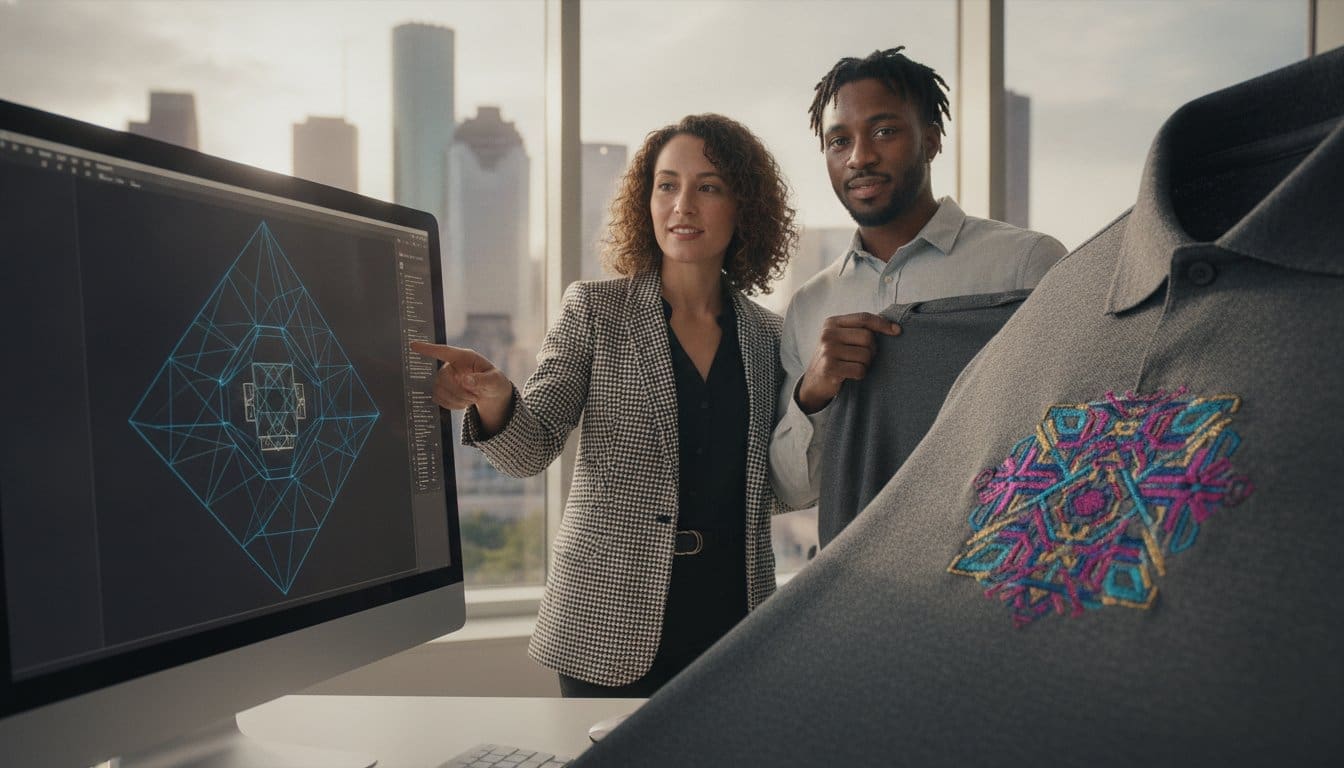
How to Migrate Your Embroidery Order: 2026 Guide
What if the most expensive part of changing your embroidery provider isn’t the shipping, but the digital files you already thought you owned? It’s frustrating to feel tethered to a shop that no longer meets your standards just because you’re worried about paying those digitizing fees all over again. You’ve worked hard to build a visual identity. The thought of thread colors shifting or fine details disappearing when you migrate your embroidery order from another shop is enough to keep anyone stuck in an unhappy partnership. We understand that your brand is a vessel for your story, and every stitch matters.
This 2026 guide will show you exactly how to reclaim your brand assets and transition to a higher-quality provider without sacrificing precision or your budget. We’ll walk through the technical audit of your digital thread legacy, explain the importance of .DST and .EMB files, and share the steps to ensure your next batch of custom polos or hats looks better than the last. You can achieve a stress-free transition that preserves your brand’s excellence while saving on unnecessary setup costs.
Key Takeaways
- Identify why securing your .DST and .EMB files is the most critical step to avoid paying for digitizing twice.
- Learn how to migrate your embroidery order from another shop while keeping your thread colors and design details perfectly intact.
- Understand the benefits of choosing a boutique Houston partner that prioritizes personal investment over industrial volume.
- Follow a clear, 5-step checklist to gather your brand assets and perform a technical audit with your new provider.
- Discover how a professional review of your existing stitch files can lead to significant cost savings on setup fees.
The Logistics of Switching: Why Migration Matters for Your Brand
Your brand’s visual identity isn’t just a marketing tool; it’s a legacy you’ve built stitch by stitch. When you decide to migrate your embroidery order from another shop, it’s often because the partnership has reached a plateau. Perhaps you’ve noticed a dip in quality, or maybe communication has become sterile and impersonal. Common reasons for switching suppliers typically include a lack of consistency or a shift in pricing that no longer reflects the value provided. Many businesses hesitate to move because they fear the “switching cost” myth. They worry that leaving means starting from scratch and paying for everything all over again. In reality, a skilled partner can often bridge that gap, preserving your brand continuity across everything from custom polos to embroidered hats without the heavy lifting you expect.
Who Owns Your Digitized Logo?
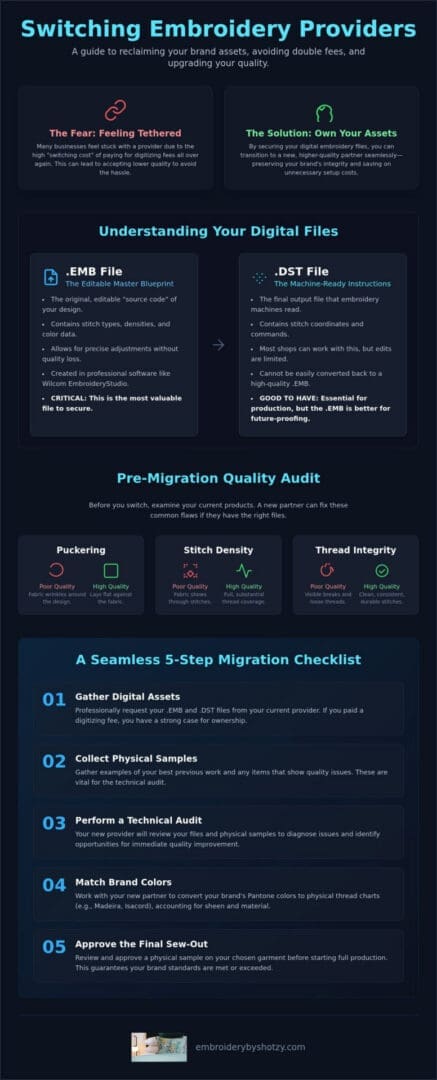
One of the biggest hurdles in migration is understanding the digital thread legacy of your logo. Your high-resolution graphic files, like a PNG or SVG, are the blueprint, but the embroidery file is the actual construction plan. For 2026, the industry standard for professional editing remains Wilcom EmbroideryStudio 2026, which uses .EMB files. The machine itself usually reads .DST files. You might find that your previous shop claims ownership of these digitized files, sometimes charging a “release fee” to hand them over. It’s standard practice to request these files professionally. If you paid a digitizing fee upfront, you have a strong case for ownership. Having these files in hand is the fastest way to migrate your embroidery order from another shop while avoiding a repeat of those initial setup costs.
Audit Your Current Embroidery Quality
Before you move, take a meticulous look at your current inventory. High-quality embroidery should feel substantial and lay flat against the fabric. If you see puckering around the edges of your embroidered bags or notice thread breaks in your custom patches, these are technical flaws in the digitizing or the machine tension. Check the stitch density; if the fabric peaks through the design, the stitch count is too low. When preparing to meet a new boutique partner, bring physical samples of your previous work. This allows a passionate artisan to audit the thread paths and identify exactly where the previous shop fell short. It ensures your brand’s transition is an upgrade in precision, not just a change of scenery.
Technical Requirements: Navigating Embroidery Files and Thread Matching
When you decide to migrate your embroidery order from another shop, you’re transferring a complex set of digital instructions that dictate how a needle interacts with fabric. This isn’t as simple as sending a high-resolution image. It involves a technical audit of your brand’s digital thread legacy. The industry relies on two primary file types: .EMB and .DST. The .EMB file is the editable “Master File” created in professional software like Wilcom EmbroideryStudio 2026. It contains the DNA of your design, including stitch types and densities. Conversely, the .DST file is the machine-readable output. While most shops can work with a .DST, having the original .EMB file allows a new partner to make precise adjustments without compromising quality. When evaluating a new supplier, their ability to interpret these files determines how smoothly your brand transitions.
The Anatomy of a Digitized File
A digitized embroidery file is a set of machine-readable coordinates for needle movement. You cannot simply “save as” a JPEG or PNG into an embroidery format. Each path must be manually plotted by a digitizer who understands how thread pulls against different materials. A file designed for a flat surface, like an apron, will often fail on a structured item like a hat. Structured headwear requires a “center-out” and “bottom-up” stitching path to prevent the fabric from shifting or “flagging” during production. If your previous provider only gave you the machine-ready .DST files, your new partner may need to perform a technical review to ensure those paths still align with your quality expectations.
Achieving Color Consistency
Color is the heartbeat of your brand identity. Most corporate logos are defined by Pantone colors, but embroidery uses physical thread from manufacturers like Madeira or Isacord. These threads have a distinct sheen that changes based on the light and the direction of the stitches. Moving your order requires a careful conversion from ink-based colors to polyester or rayon thread charts. We also have to manage dye lot variations. Even the same thread color can look slightly different if it was produced in a different batch. At Embroidery By Shotzy, we treat this matching process with the meticulousness of an art restoration; we ensure your brand’s palette remains vibrant and consistent across every garment type. This level of personal investment prevents the subtle color shifts that often plague bulk volume migrations.
Precision matters. A logo that looks beautiful on a custom polo might require a different stitch density to appear equally sharp on embroidered scrubs or heavy bags. By understanding these technical requirements, you ensure that when you migrate your embroidery order from another shop, the result is an upgrade in craftsmanship rather than a compromise in quality.
Evaluating Your New Houston Embroidery Partner
Choosing where to migrate your embroidery order from another shop is a decision that extends far beyond a simple price comparison. It’s a search for a creative partner who views your brand assets as a legacy to be protected rather than just another file in a production queue. While large industrial factories prioritize volume and throughput, a boutique partner offers a level of meticulousness that industrial machines alone cannot replicate. This distinction is vital when you’re dealing with complex logos on high-stitch-count items like embroidered hats or professional scrubs. In a boutique setting, every project receives personal investment, ensuring that the transition results in an immediate elevation of your brand’s physical presence.
Local accountability plays a significant role in this partnership. For corporate clients in Houston, having a provider you can visit or call directly creates a layer of trust that faceless online vendors lack. Modern technology is still essential; a shop should utilize high-speed multi-head machines to ensure precision and efficiency for bulk orders of custom polos or aprons. However, the technology must be guided by a passionate artisan who understands how to calibrate those machines for different fabric weights. Moving from a transactional relationship to a collaborative one means your provider acts as a consultant, helping you navigate thread choices and placement to achieve the most impactful result.
Questions to Ask a Potential New Shop
Before committing to a new provider, use these specific questions to gauge their expertise and willingness to support your migration:
- Do you charge a setup fee if I provide my own digitized .DST or .EMB files? A partner like Shotzy can often work with your existing files to save you money, provided the quality meets professional standards.
- Can you provide a sew-out sample for approval before the full production run? Physical proofing is the only way to guarantee that your brand’s visual identity remains intact during the move.
- What is your specific process for matching thread to my existing brand palette? Ensure they use industry-standard charts from Madeira or Isacord to maintain color continuity.
The Value of Local Houston Craftsmanship
There is an inherent advantage to working with an independent Houston artisan. Local shops often provide flexible “drop-off” options for your own apparel, such as specialized embroidered bags or monogrammed towels, which saves on shipping costs and transit time. This proximity allows for faster troubleshooting; if a thread color doesn’t look right under office lighting, you can resolve the issue in person rather than through a series of emails. Supporting a local business like Embroidery By Shotzy means you’re investing in a master of the craft who is genuinely enthusiastic about the collaborative nature of custom work. This local connection ensures that when you migrate your embroidery order from another shop, your brand receives the high-precision care it deserves.
A Seamless 5-Step Migration Checklist
Moving your brand’s legacy requires more than just a new shipping address. To successfully migrate your embroidery order from another shop, you need a methodical approach that protects your visual identity. This five-step checklist ensures that your transition is an upgrade in quality rather than a logistical headache. We treat every migration as a collaborative journey to bring your vision to life with better precision.
- Gathering Your Assets: Reclaim your high-resolution art and any existing stitch files from your previous provider.
- The Technical Review: Have your new boutique partner audit these files for compatibility and stitch quality.
- Sampling and Approval: Execute a “sew-out” phase to verify that the design translates perfectly to the new machinery.
- Inventory Transition: Coordinate the hand-off of any remaining blank garments, custom patches, or specialized threads.
- Finalizing the Bulk Run: Set clear expectations for volume, delivery timelines, and quality standards for the first full production.
Phase 1: Asset Collection
Your first task is to reclaim your digital property. Request a full export of your brand’s embroidery assets from your current vendor. You should aim to collect vector art files like .AI or .PDF, alongside machine-specific files such as .DST or .PES. Don’t forget to record the specific thread brands and color codes used in the past to maintain continuity. It’s also helpful to take high-quality photos of your best previous embroidery results. This documentation allows a passionate artisan to identify exactly where your previous shop succeeded and where their craftsmanship could be improved.
Phase 2: The Pilot Run
Never skip the sample stitch-out when you migrate your embroidery order from another shop. A “sew-out” is a physical test of your design on a scrap piece of the same fabric you intend to use for the final order. Machinery varies between shops; the pull-compensation and density settings that worked for one provider might cause puckering or gaps on another. Testing the design on different textures, like the soft pile of personalized baby blankets or the heavy weave of embroidered bags, ensures the design is perfectly calibrated for each item. This phase is where technical precision meets personal connection, ensuring your brand looks its best on every surface.
Once the pilot run is approved, you’re ready to move into full production with confidence. If you’re looking for a partner who values meticulousness, you can start your brand migration with Embroidery By Shotzy today to ensure your logo is handled with the care it deserves.
Why Embroidery By Shotzy is the Ideal Home for Your Brand
Transitioning your brand identity is a significant step that requires trust and a shared commitment to excellence. When you choose to migrate your embroidery order from another shop, you’re looking for more than just a new service provider; you’re seeking a steward for your brand’s digital thread legacy. Since 2014, Embroidery By Shotzy has served as a Houston-based creative partner, focusing on the intersection of technical precision and personal connection. We don’t just process orders. We bring your unique vision to life through a boutique-style approach that emphasizes personal investment in every project, ensuring your logo is treated with the respect it deserves.
Precision is our hallmark, especially when handling challenging items that require a master’s touch. High-stitch-count designs on structured hats, custom aprons, or personalized baby blankets require a level of care that industrial manufacturing often overlooks. We utilize advanced technology to ensure every needle movement is purposeful and every thread tension is perfectly calibrated. Our pricing model is built on transparency and fairness. We offer one-time logo digitizing fees and bulk volume pricing, but we also look for ways to save you money. If your existing files are high-quality and professionally digitized, we’ll work with them to eliminate redundant setup costs and provide a seamless hand-off.
Boutique Care for Corporate Clients
Managing large-scale orders shouldn’t mean sacrificing the artisan touch that makes your brand stand out. We provide custom solutions for professional uniforms, ranging from embroidered scrubs to promotional polos, ensuring that bulk volume doesn’t lead to a dip in quality. Our creative collaboration process is designed to be methodical and purposeful. We act as your guide, moving smoothly from initial inspiration to the final execution. You’ll never feel like just another number in a queue because we treat your corporate logo as a legacy, not just a file.
Ready to Make the Move?
Starting your migration is simpler than you might think. It begins with a straightforward file review where our experts audit your current assets for compatibility and excellence. We stand behind our work with the Shotzy Guarantee of craftsmanship and precision, ensuring your brand transition is seamless and stress-free. Every physical item we create serves as a vessel for your professional story, and we’re honored to help you tell it with the highest quality stitching available in Houston.
Let’s bring your brand’s story to life with a fresh start at Embroidery By Shotzy.
Reclaiming Your Brand’s Digital Thread Legacy
Moving your production shouldn’t feel like a leap of faith. By securing your original .EMB and .DST files and insisting on a technical sew-out, you protect the visual identity you’ve worked so hard to build. Remember that a successful transition is as much about the partnership as it is about the machinery. When you migrate your embroidery order from another shop, you’re choosing to invest in a team that treats your logo as a lasting narrative rather than a temporary task.
Since 2014, we’ve helped corporate and individual clients across Houston bring their unique visions to life with expert logo digitizing and a meticulous eye for detail. Whether you’re moving a bulk run of custom polos or a specialized set of embroidered hats, we’re here to ensure the transition is seamless and rewarding. Your brand deserves the precision of a passionate artisan. Start Your Seamless Migration to Embroidery By Shotzy Today and let’s begin the next chapter of your story together.
Frequently Asked Questions
Can I use the same embroidery file from my old shop?
Yes, you can typically use the same file if it’s in a universal format like .DST or the master .EMB format. However, we always perform a technical review to ensure the previous digitizer’s stitch paths meet our boutique quality standards. If the file was designed for a flat item like a polo but you now want embroidered hats, we might need to adjust the settings for the best result.
Will my logo look exactly the same if I switch providers?
Your logo will maintain its core identity, though you might notice a distinct improvement in precision and clarity. Different machines and thread tensions can subtly affect the finished product. We use advanced technology to ensure that when you migrate your embroidery order from another shop, the stitch density and pull-compensation are perfectly calibrated. This meticulousness prevents the puckering or gaps often found in industrial-scale production runs.
Do I have to pay a digitizing fee again if I already have the file?
You won’t have to pay a new digitizing fee if you provide a professionally digitized .DST or .EMB file that passes our quality audit. We believe in being a creative partner rather than a faceless factory, so we strive to work with your existing assets to save you money. If the file requires significant repairs or wasn’t designed for your chosen garment, we’ll discuss any necessary one-time setup adjustments before starting.
How do I get my embroidery files from my current shop?
You can simply send a professional email to your current provider requesting your digitized files, specifically mentioning .DST and .EMB formats. If you paid an initial setup or digitizing fee, you typically own the rights to those files. Most Houston shops are accustomed to these requests. Having these files in your possession makes it much easier to migrate your embroidery order from another shop while preserving your brand’s visual legacy.
What if I don’t have my original embroidery files, only a picture?
We can certainly work from a high-resolution image like a JPEG, PNG, or vector file, but it will require a new digitizing process. Our skilled team will manually convert your artwork into a machine-readable format to ensure every stitch reflects the quality of your brand. This one-time service transforms your flat image into a textured reality, perfect for everything from custom patches to professional embroidered scrubs.
Is there a minimum order size for migrating my account to Embroidery By Shotzy?
We welcome projects of all sizes, from a single personalized baby blanket to bulk corporate uniform orders. Our boutique approach allows us to give the same level of care to an individual gift as we do to a large run of custom polos for a local Houston business. We offer bulk volume pricing to reward larger quantities, making us a flexible partner for your growing brand needs.
How long does the migration process usually take?
The timeline for migration depends on the complexity of your design and the availability of your files, but we aim for a methodical and purposeful transition. Once we receive your digital assets and perform our technical review, we move quickly into the sampling phase. This steady pace ensures you feel supported without feeling rushed. We’ll provide a clear timeline after reviewing your specific project requirements and garment choices.
Can you match the thread colors used by my previous embroidery shop?
We can match your existing palette with high precision using industry-standard thread charts from Madeira or Isacord. If you have the specific thread codes from your previous orders, we’ll use those as our guide. Otherwise, we perform a physical color match against your previous garments to ensure your brand’s visual identity remains consistent across your new custom aprons, monogrammed towels, or embroidered bags.