How Much Does it Cost to Digitize a Logo for Embroidery in 2026?
Why does a perfectly crisp digital image often transform into a puckered, thread-breaking mess the moment it meets a needle and thread? The truth is that your logo isn’t just a picture; it’s a narrative that needs a technical blueprint to come to life on fabric. Understanding the cost to digitize a logo for embroidery is the first step in ensuring your brand’s story is told with the precision and excellence it deserves.
It’s common to feel a bit of friction when faced with setup fees or the realization that a standard graphic file isn’t ready for the machine. You want your custom polos, embroidered hats, or aprons to reflect the meticulous care you put into your own work. We’ll help you discover the transparent factors behind these professional fees and how to achieve machine-ready results that elevate your brand. This guide previews the nuances of stitch counts, the value of manual craftsmanship over automated shortcuts, and how to ensure your one-time investment pays off in every future order.
Key Takeaways
- Understand that digitizing is a technical blueprint, not a simple file conversion, ensuring your brand translates perfectly from screen to thread.
- Learn how the cost to digitize a logo for embroidery is determined by intricate factors like stitch count and design complexity.
- Avoid common pitfalls like puckering and thread breaks by recognizing the long-term value of professional craftsmanship over cheap, automated files.
- Discover practical tips for preparing your artwork to minimize setup time and achieve a crisp, machine-ready finish.
- Explore how a personalized, boutique approach transforms your logo into a lasting mark of excellence on your custom gear.
What is Embroidery Digitizing and Why is There a Cost?
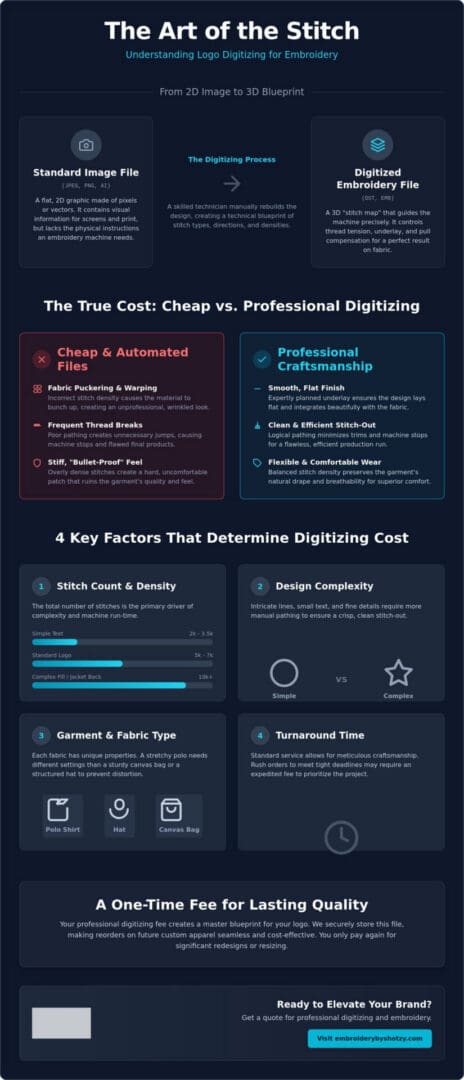
Every great piece of custom apparel begins with a silent conversation between software and fabric. While it’s easy to think of digitizing as a simple “Save As” function, it’s actually the bridge between a conceptual brand identity and a tangible masterpiece. The cost to digitize a logo for embroidery reflects the technical expertise required to translate a 2D image into a complex sequence of stitch commands that a machine can execute with precision.
Commercial embroidery machines don’t understand the pixels found in a JPEG or the mathematical paths of a vector PNG. They require specific instructions on where the needle should drop, which color to pull, and how many thousands of times it must repeat those actions to create a solid fill. A standard image file lacks this data; it has no concept of thread tension or how different fabrics react to being pierced by a needle. Without a digitizer to map out this journey, the machine simply wouldn’t know how to begin.
The digitizer acts as a choreographer for your brand. They plan every movement, deciding on the “pathing” to minimize unnecessary jumps and thread trims. They also build the “underlay,” which is a hidden foundation of stitches that stabilizes the fabric before the visible design is ever applied. This level of meticulous planning protects your investment in high-quality items like custom polos or embroidered bags. A well-digitized file ensures that your logo doesn’t just look good on a screen, but remains crisp and professional after dozens of washes.
The Difference Between Graphic Design and Digitizing
Graphic design is focused on how light reflects off a screen or how ink sits on a flat piece of paper. Digitizing must account for the physical reality of thread and the flexible nature of cloth. Your graphic designer creates beautiful vectors, but they rarely deal with “pull compensation.” This is the art of adjusting a design to account for how fabric naturally cinches when stitches are applied. A perfect circle in a graphic file can easily become an oval on a shirt if the digitizer doesn’t manually compensate for that physical movement during the setup process.
Is the Digitizing Fee a One-Time Charge?
In the world of professional craftsmanship, the digitizing fee is typically a one-time investment for a specific design. Once we create that “master file,” it becomes part of your brand’s narrative. At Embroidery By Shotzy, we store your files securely in our Houston studio to ensure that reordering your custom gear is a seamless, stress-free experience. You’ll generally only face a new fee if you require a significant change. This might include scaling a small left-chest logo up to a large jacket back or moving a design from a stable cotton apron to a highly textured, stretchy fleece that requires a completely different stitch structure.
4 Key Factors That Determine the Cost to Digitize a Logo
Every design presents a unique set of technical challenges that require a human touch to solve. The cost to digitize a logo for embroidery isn’t a fixed commodity because every brand story is different. Several technical variables influence the labor and expertise required to turn your vision into a machine-ready file that performs flawlessly on the production floor.
Stitch count is the primary driver of both time and complexity. While a simple text-based logo might only require 2,000 to 3,500 stitches, a standard left-chest logo typically ranges from 5,000 to 7,000 stitches. If your design features large, solid areas of color, that count can quickly climb to 10,000 or more. Beyond the sheer volume, the complexity of the artwork—such as intricate line work or tiny details—demands more manual pathing from the digitizer to ensure the machine doesn’t snag or break threads.
Your choice of garment also dictates the technical blueprint. A logo destined for a soft, stretchy polo requires different stabilization and pull compensation than one meant for a heavy canvas bag. Finally, the timeline matters. For those preparing for a last-minute corporate event or community gathering in Houston, rush fees can impact the final price. Planning ahead allows for the meticulousness your brand deserves without the added expense of an expedited turnaround.
Stitch Count and Density Explained
The density of your design determines how the finished product feels against the skin. We use “fill stitches” for large areas and “satin stitches” for borders and text. A common mistake in cheap digitizing is over-densifying the file, which creates a “bullet-proof” effect. This results in a stiff, uncomfortable logo that can cause the fabric to pucker. A skilled artisan balances coverage with flexibility, ensuring your custom polos remain breathable and professional.
The “Hat vs. Flat” Technical Requirement
The physical shape of the item changes the digitizing strategy entirely. Standard “flat” items like custom aprons or towels allow for flexible pathing. However, structured hats require a specialized “center-out and bottom-up” approach. This specific sequence prevents the fabric from shifting on the curved surface of the cap. Because these technical requirements are so different, you’ll often need separate digitized files if you plan to move your logo from a flat shirt to a structured hat.
Complexity also hides in the fine print. Small text, especially anything under 0.25 inches, requires surgical precision during the digitizing phase. Without careful planning of the thread’s “sinkage” into the fabric, small letters can become illegible. We take the time to adjust these minute details so your brand remains clear and impactful, regardless of the scale.
Cheap vs. Professional Digitizing: The Real Cost of a $10 File
Low-cost digitizing services often promise the world for a few dollars, but the hidden expenses typically reveal themselves on the production floor. While the initial cost to digitize a logo for embroidery might seem lower with these budget providers, the downstream impact on your brand’s quality can be staggering. A cheap file isn’t just a bargain; it’s often a liability that leads to “thread break” nightmares, where the machine stops every few minutes because the stitch paths are tangled or illogical.
Poorly digitized files frequently suffer from puckering and misalignment. This happens when the software fails to account for the physical “push and pull” of the fabric. You might see gaps between the outline and the fill, or the fabric might bunch up unpleasantly around the design. These flaws are especially visible on high-quality items like custom polos or personalized baby blankets, where the texture of the material demands a more sophisticated touch. Beyond the aesthetic issues, bad digitizing causes “birds-nesting,” a technical failure where thread bunches up under the needle plate, leading to unnecessary wear and tear on expensive embroidery equipment.
Choosing a boutique expert in Houston provides a distinct advantage. We don’t just run your logo through a program; we hand-test the file to ensure every movement is purposeful. This meticulous craftsmanship ensures that your design runs smoothly from the first stitch to the last, preserving the integrity of both the machine and the garment.
Why “Auto-Digitizing” Software Often Fails
AI-driven conversion tools are becoming common, but they lack the artisan’s eye for detail. Auto-digitizing software often struggles with complex logos, misinterpreting fine lines as solid blocks or failing to recognize where one color should end and another begin. It doesn’t understand that thread has physical volume. Human digitizers catch these nuances, adjusting the density of small text so it remains legible rather than turning into a cluttered knot of thread. “Free” or ultra-cheap digitizing usually skips this vital human review, leading to poor results that require expensive corrections later.
Protecting Your Garments
The greatest risk of a sub-par file is the potential to “eat” a garment. When a needle gets stuck in a poorly digitized area with excessive density, it can tear a permanent hole in the fabric. We prioritize precision to protect your investment in embroidered scrubs or custom bags, ensuring the needle glides through the material as intended. Pull compensation is the intentional adjustment of a design’s width or height to counteract the natural tendency of fabric to cinch and pull inward as the needle applies thread. This technical correction prevents unsightly gaps and ensures your logo looks exactly like the original artwork once it’s fully stitched out.
How to Prepare Your Logo to Minimize Digitizing Costs
The path to a flawless finish begins long before the first needle drop. While our team handles the heavy lifting of technical mapping, your initial artwork preparation plays a significant role in the process. Providing high-resolution vector files like AI, EPS, or PDF is the most effective way to manage the cost to digitize a logo for embroidery. These files allow us to see the exact geometry of your design without the “noise” of pixelated edges, leading to a cleaner blueprint and a more efficient setup.
Simplicity is often the secret to a sophisticated embroidered result. If your logo includes intricate text under 0.25 inches, we may suggest slight adjustments to ensure the thread remains legible. Similarly, reducing unnecessary color counts can streamline the process. Every thread change requires a specific command in the file; by focusing on your brand’s core palette, you create a design that is both cost-effective to set up and visually striking on the final garment.
The Ideal Artwork Checklist
Thread behaves differently than ink, and your artwork should reflect that physical reality. Gradients are a common hurdle; while a printer can blend colors seamlessly, embroidery requires “step fills” or manual blending to mimic a fade. Auditing your font choices is also vital. Serif fonts, with their tiny decorative feet, are often trickier to execute at small scales than clean sans-serif options. Finally, ensure your files have transparent backgrounds. This prevents the machine from adding unnecessary “fill” stitches in areas that should remain the natural color of your fabric.
Choosing the Right Garment First
The weight and texture of your chosen fabric dictate how we build the stitch file. A heavy, structured hoodie can support a much denser design than a thin performance tee. We often recommend using custom polos as a baseline for logo testing because their stable knit provides an excellent canvas for most brand identities. Consulting with your Houston embroidery partner before finalizing a new logo design can save you from costly revisions later.
We believe that every stitch should serve a purpose, and your preparation ensures that your brand’s legacy is captured with absolute precision. If you are ready to see your vision transformed into a professional, machine-ready reality, contact our Houston studio today to discuss your project requirements.
The Embroidery By Shotzy Difference: Houston’s Boutique Digitizing
At Embroidery By Shotzy, we believe your brand deserves more than a generic file conversion. We treat every logo as a physical legacy, ensuring the cost to digitize a logo for embroidery translates into a lifetime of crisp, professional results. Our boutique approach means we don’t just “process” your artwork; we collaborate with you to understand the story you want your apparel to tell. Whether it’s a delicate personalized baby blanket or a set of rugged custom patches, every stitch is optimized for the specific material it touches. We view each garment as a vessel for your professional story, requiring the perfect balance of tension and density.
This level of meticulous craftsmanship is the reason we offer a one-time setup fee for your master files. Once your design is perfected and tested, it’s archived in our Houston studio to make reordering a seamless experience. You won’t face recurring setup costs for that specific design on future orders of the same size, making it a sustainable investment for your brand’s long-term growth. We act as your “Friendly Expert,” taking the time to explain the technical “why” behind our choices so you feel like a true partner in the creative process rather than just a customer.
Custom Solutions for Houston Businesses
Being a local partner in Houston allows us to offer a level of service that distant, automated factories simply can’t provide. You have the unique advantage of working with artisans who understand the local landscape. You can visit our studio for precise thread color matching or to see physical samples of our work on various fabrics. We provide tailored solutions for a wide range of local needs, from professional corporate polos to specialized name tapes for flight suits. For Houston schools, healthcare teams needing embroidered scrubs, and community organizations, our bulk volume pricing ensures that boutique-level quality remains accessible even as you scale your project.
Get Started with Your Custom Design
Starting your project is a straightforward, purposeful process designed to remove the guesswork. When you submit your logo for a professional quote, we conduct a thorough review of your artwork’s technical requirements. We’ll discuss placement, garment types, and any necessary adjustments to ensure the thread behaves exactly as intended. This collaborative review ensures there are no surprises when the machine starts running. We’re here to guide you from your initial conceptual vision to a concrete, physical reality that you’ll be proud to wear.
Ready to bring your logo to life? Contact Embroidery By Shotzy today!
Invest in the Future of Your Brand Identity
Choosing the right path for your brand’s physical identity is a decision that resonates through every garment you wear. You’ve seen how the cost to digitize a logo for embroidery is an investment in technical precision that prevents puckering, thread breaks, and ruined materials. By prioritizing high-resolution artwork and choosing a partner who understands the specific requirements of different fabrics, you ensure that your first order is as perfect as your hundredth.
Since 2014, we’ve dedicated ourselves to the art of high-stitch-count precision right here in our Houston studio. We don’t just create files; we craft the blueprints for your professional story. If you’re ready to see your vision transformed with local Houston craftsmanship and meticulous care, we’re here to guide you. Get a Custom Digitizing Quote from Embroidery By Shotzy and take the first step toward a crisp, machine-ready result that truly represents your excellence. We’re excited to help you bring your vision to life on the fabric of your choice.
Frequently Asked Questions
Is digitizing a one-time fee for embroidery?
Yes, the digitizing fee is typically a one-time investment for a specific design at a set size. Once your master file is created and tested, we archive it in our Houston studio for all your future orders. You’ll only face a new charge if you decide to significantly change the logo’s size or if you want to move the design to a vastly different fabric that requires a new technical blueprint.
Can I digitize my own logo for free?
While free auto-digitizing software exists, it rarely produces the professional results your brand deserves. These automated tools don’t understand how thread interacts with fabric, often leading to thread breaks or puckering. Investing in professional craftsmanship ensures your logo looks crisp on everything from custom polos to personalized baby blankets, saving you the cost of ruined garments and wasted time.
Why is digitizing so expensive compared to the embroidery itself?
Digitizing is a manual, technical art form that requires a skilled artisan to map out every single needle drop. The cost to digitize a logo for embroidery reflects the hours spent planning pathing, underlay, and pull compensation. In contrast, the embroidery price covers the machine’s run time and the physical thread. You’re paying for the expert “blueprint” that makes the automated embroidery possible.
What file format do I need for embroidery digitizing?
High-resolution vector files like .AI, .EPS, or .PDF are the ideal starting point for any project. These formats allow us to see the clean geometry of your design without the blurriness of pixels. While we can work with high-quality .JPG or .PNG files, vector artwork ensures the most accurate translation from a digital concept to a physical, stitched reality on your custom gear.
Does the size of my logo change the digitizing cost?
Yes, the scale of your design directly impacts the complexity and stitch count of the file. A small logo meant for the front of embroidered hats requires a completely different stitch structure than a large design for the back of a jacket. Because the pathing and density must be manually recalculated for different dimensions, each significant size variation usually requires its own unique digitized file.
Can you digitize a photo for embroidery?
Photos can be digitized, but they require a specialized approach to translate millions of pixels into a limited palette of thread colors. This process often involves simplifying the image into a stylized version that captures the essence of the original. We focus on creating a design that is durable and legible, ensuring your personalized gifts or commemorative items maintain their beauty over time.
How long does it take to digitize a logo for a rush order in Houston?
Standard turnaround for a professional file is usually a few business days, but we can often accommodate rush orders within 24 to 48 hours. Being a local Houston partner allows us to prioritize urgent requests for upcoming corporate events or community gatherings. While rush fees may apply, we never sacrifice the meticulousness required to ensure your design runs perfectly on the machine.
What happens if I want to change my logo later?
Minor adjustments, like changing a thread color, are simple and often don’t require a new file. However, if you decide to change the font, move a graphic element, or add new details, the cost to digitize a logo for embroidery will apply to the new version. We recommend finalizing your brand’s visual story before the digitizing phase to ensure your investment serves you for years to come.