Durable Embroidery Guide for Long-Lasting Uniforms
Imagine handing out fresh uniforms to your crew on a Monday morning, only to see the logos fraying and the colors bleaching under the relentless Houston sun by the following month. It is a disheartening cycle that drains your budget and quietly erodes your brand’s professional image. You deserve a partner who views your logo not just as a decoration, but as a lasting mark of your company’s legacy. Finding truly durable embroidery for workwear is often the difference between a team that looks polished and one that looks worn out before the job is even done.
We understand that your uniforms need to work as hard as your people do. In this guide, we’ll reveal the technical secrets behind embroidery that outlasts the toughest conditions, from high-tensile polyester threads to the meticulous digitizing process that prevents puckering on modern performance fabrics. You will learn how to select Houston-ready garments and backing materials that remain comfortable even in 90% humidity. By focusing on the intersection of technical precision and quality craftsmanship, you can ensure your team maintains a professional edge that stands the test of time and every heavy-duty wash cycle.
Key Takeaways
- Learn why 100% polyester thread is the industry gold standard for withstanding heavy-duty industrial washes and intense UV exposure.
- Understand how selecting the proper “cut-away” stabilizer provides the permanent foundation required for durable embroidery for workwear.
- Discover how to balance fabric weight with design density to prevent puckering, specifically tailored for Houston’s high-humidity climate.
- Explore how professional digitizing creates a high-precision “master file” that eliminates snags and protects your long-term branding investment.
- See how a boutique approach to quality inspection ensures every custom polo or work shirt meets the highest standards of craftsmanship.
Why Workwear Demands More: The Limits of Standard Embroidery
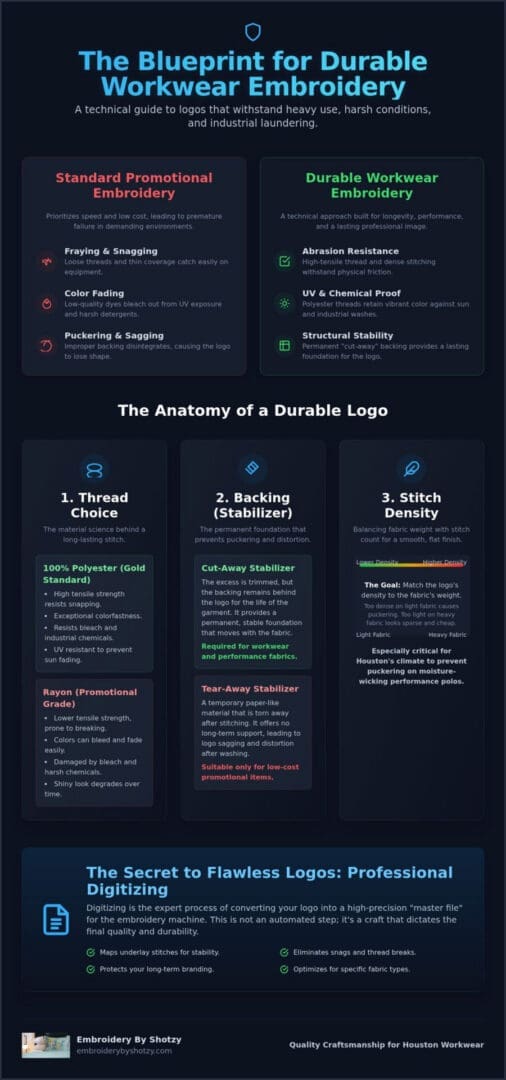
A company uniform is more than just fabric; it’s a mobile billboard for your reputation. While standard embroidery might suffice for a giveaway hat at a trade show, industrial workwear lives a much harder life. Promotional stitching often prioritizes production speed and low cost, leading to loose threads and thin coverage. In contrast, durable embroidery for workwear requires a meticulous approach that accounts for the physical demands of a long shift. When a logo begins to fray, it doesn’t just look messy; it tells your clients that you might overlook the small details in your own craft.
High-volume industrial laundering is the ultimate test of thread integrity. Standard rayon threads, though shiny and attractive, often succumb to the high heat and harsh chemicals used in commercial washers. Over time, poor-quality backing material can disintegrate, causing the logo to pucker, sag, or lose its shape entirely. This creates a hidden financial burden for your business. When a logo fails, the entire garment often needs replacement long before the fabric itself wears out. This shortens your return on investment and forces you into a frequent, expensive replacement cycle.
The Stress of the Job Site
Physical friction is an everyday reality for technicians, builders, and service providers. Whether it’s a sleeve rubbing against a ladder or a chest logo catching on equipment, abrasion resistance is non-negotiable. Beyond physical wear, chemical exposure from heavy-duty detergents and acidic sweat can bleach low-quality dyes. In Houston, we also face the relentless Texas sun. Without UV-resistant polyester threads, a vibrant navy logo can fade to a dull grey in just a few months of outdoor exposure. We focus on materials that retain their brilliance despite these environmental challenges.
Embroidery vs. Screen Printing for Longevity
Many businesses weigh the pros and cons of different decoration methods. For textured garments like custom polos, embroidered scrubs, or rugged jackets, embroidery is the superior choice for longevity. Unlike ink that sits on the surface and can eventually crack or peel, thread is woven directly into the fabric’s architecture. This creates a three-dimensional bond that moves with the garment and withstands the stretching and pulling common in active trades.
Choosing durable embroidery for workwear also provides a professional edge that other methods cannot match. A high-density embroidered logo adds a sense of weight and authority to your brand. According to industry data, high-density stitching can increase the perceived value of a brand by up to 40%. It signals to your customers that you value excellence and have invested in quality that lasts. This makes it a strategic choice for client-facing trades where a first impression is often the only one you get.
The Anatomy of Durable Embroidery: Thread, Backing, and Density
Creating a logo that survives the rigors of the field starts with understanding the mechanical blueprint of the stitch. While the garment provides the canvas, the combination of thread material, stabilizer choice, and stitch density determines whether your branding will last for years or fail after the first few washes. Achieving durable embroidery for workwear is a technical balancing act that requires a deep knowledge of how different materials interact under stress. It’s about building a structure that moves with the fabric rather than fighting against it.
Before the first needle drop, the foundation must be set through Professional Digitizing. This process maps out underlay stitches, which act as an invisible scaffolding. These foundation stitches are buried beneath the top layer of thread to prevent the final design from sinking into the fabric or losing its shape. Without proper underlay, even the most expensive thread will eventually look flat and distorted as the garment ages.
Polyester vs. Rayon: The Durability Debate
In the world of professional apparel, 100% polyester has become the undisputed gold standard. Unlike rayon, which offers a high sheen but lacks structural integrity, polyester possesses incredible tensile strength. This allows it to withstand the high-speed friction of industrial embroidery machines and the daily physical demands of a job site. High-tensile polyester thread is the primary requirement for workwear longevity because it resists snapping under tension and maintains its color when exposed to harsh cleaning agents. For businesses that rely on embroidered scrubs or hospitality uniforms, polyester’s bleach resistance is an essential feature that keeps logos looking new despite frequent, high-temperature sanitization.
Choosing the Right Backing (Stabilizer)
The stabilizer is the unsung hero of any embroidered piece. For workwear, we almost exclusively recommend cut-away stabilizers. Unlike tear-away versions that can break down over time, cut-away backings provide permanent support that remains for the life of the garment. This is especially critical for stretchy performance fabrics and custom polos, as it prevents the logo from puckering or rippling after it has been through ten or twenty wash cycles. To ensure wearer comfort, we can apply soft-touch covers over the backing, eliminating the itchy sensation often associated with heavy-duty embroidery. This attention to detail ensures your team stays comfortable while looking sharp.
Finding the “sweet spot” for stitch density is the final piece of the puzzle. If the density is too low, the fabric shows through and looks unprofessional. If it’s too high, the design becomes a stiff, uncomfortable patch that pulls on the shirt. We calibrate every design to ensure durable embroidery for workwear that offers a premium, tactile feel while remaining flexible and resilient through every shift.
Selecting the Right Canvas: Durable Fabrics for Houston’s Climate
In Houston, the heat is a constant factor that dictates every choice we make, especially regarding what we wear to work. Choosing the right garment is just as critical as the stitch itself when aiming for durable embroidery for workwear. A heavy design on a flimsy shirt leads to sagging and discomfort, while a lightweight stitch on heavy canvas can look lost or unprofessional. We believe in finding the perfect harmony between the needle and the thread to ensure your team stays cool without sacrificing the longevity of their uniforms.
Fabric weight, measured in GSM (grams per square meter), must be carefully balanced against the complexity of your logo. While a 100% cotton shirt might feel soft at first touch, it often lacks the structural resilience needed to support a high-density logo through fifty industrial wash cycles. We frequently recommend 60/40 cotton-polyester blends. The polyester provides dimensional stability, preventing the “bacon collar” effect and ensuring the embroidery doesn’t pull or distort the fabric over time. When selecting a base garment, we look for materials that meet rigorous AATCC durability testing standards for colorfastness and shrinkage, ensuring your brand remains vibrant even in 90% humidity.
Performance Polos and Moisture-Wicking Fabrics
Lightweight performance gear is a favorite for Houston’s outdoor trades, but it presents unique challenges. These thin, stretchy fabrics are prone to “snagging” if the embroidery isn’t handled with a boutique level of care. To combat this, we digitize logos specifically for moisture-wicking materials, using a lighter stitch density and specialized underlay that provides support without adding bulk. This careful calibration ensures that your durable embroidery for workwear remains crisp even on the most athletic fabrics, allowing your team to move freely while maintaining a polished appearance.
Heavy-Duty Options: Canvas and Twill
For those in construction or industrial services, heavy-duty canvas and twill are the standard. Embroidering on rugged materials, such as those found in custom aprons or industrial jackets, requires a different set of tools. We utilize larger needles and thicker, high-tensile threads to penetrate these dense fibers without causing damage. This approach ensures that even highly detailed logos remain legible on textured fabrics. By treating these heavy garments with the same meticulousness as a delicate polo, we create a finished product that is as tough as the people wearing it, standing up to physical friction and chemical exposure day after day.
Professional Digitizing: The Secret to Long-Lasting Logos
Digitizing is the invisible bridge between a digital graphic and a physical garment. It is the sophisticated process of converting your logo, often a JPEG or vector file, into a precise “path” that guides the embroidery needle with mathematical accuracy. This step is where the true longevity of your branding is determined. When we talk about durable embroidery for workwear, the quality of this digital map is just as important as the thread itself. A poorly digitized file causes frequent thread breaks and creates “jump stitches,” which are long strands of thread between parts of the design. In a rugged work environment, these loose strands are magnets for snags that can quickly unravel your entire logo.
At Embroidery By Shotzy, we treat our one-time digitizing fee as a vital investment in your brand’s legacy. This fee covers the creation of a “master file” optimized specifically for the rigors of the workplace. Unlike generic services that rely on automated software, we manually plot every stitch to ensure the design remains stable through years of use. We also account for the physical “push and pull” of the fabric. Because needles pull threads tight, a perfect circle in a digital file can easily become an oval on a shirt. A professional digitizer anticipates this movement, adjusting the path so the finished logo is geometrically perfect and structurally sound.
Manual vs. Auto-Digitizing
Many high-volume providers offer “free” auto-digitizing, but this often leads to a chaotic stitch path that lacks foresight. Auto-digitizing software frequently adds unnecessary stitches that can make the logo feel like a heavy, stiff plate or cause the needle to tear the fabric. Manual pathing allows us to reduce thread tension and ensure the needle follows a logical, efficient route. Push compensation is a critical factor in digitizing for heavy fabrics, acting as a calculated adjustment that adds extra width to design elements to ensure they retain their intended shape once the thread settles into the weave.
Optimizing for Small Text and Fine Details
Small text is often the first part of a logo to fail if not handled with care. To maintain readability and strength, we generally recommend a minimum height of 0.2 inches for embroidered letters. If a logo is too complex, we work with you to simplify the elements for better long-term wearability. We use satin stitches for borders and text to provide a smooth, premium finish. Fill stitches are reserved for larger areas to add maximum strength and a rich, textured appearance. This level of meticulousness ensures your team looks sharp from the first day to the last.
Ready to create a logo that stands the test of time? Contact us to start your precision digitizing today.
Custom Uniforms in Houston: Partnering with Embroidery By Shotzy
Selecting a partner for your company’s apparel is a significant decision that impacts both your budget and your professional identity. When you choose a local Houston partner, you aren’t just placing an order; you’re starting a collaborative journey to bring your brand’s story to life on fabric. At Embroidery By Shotzy, we combine technical precision with a boutique-style commitment to quality. Being local allows us to offer personalized service and physical samples, ensuring that the durable embroidery for workwear we produce meets your exact expectations before a single needle moves. This proximity fosters a level of trust and meticulousness that high-volume, distant manufacturers simply cannot replicate.
Our expertise extends across a wide range of essential professional gear. Whether you need high-precision embroidered scrubs for a medical team or rugged custom aprons for a local bistro, we apply the same meticulous standards to every item. From custom hats that withstand the Texas sun to professional polos that stay crisp through every wash, our goal is to provide workwear that serves as a vessel for your company’s legacy. We treat every project as a personal investment, inspecting each piece to ensure it meets our rigorous standards for craftsmanship. This hands-on approach guarantees that the finished product reflects the care and dedication you put into your own business.
Bulk Order Solutions for Local Teams
Scaling your brand requires absolute consistency. Whether you’re ordering ten shirts or a hundred, your logo must remain identical in color, density, and placement. Our process relies on the high-precision master file created during our initial digitizing phase, which guarantees that the hundredth garment is just as sharp as the first. We provide volume pricing for corporate uniforms and promotional merchandise, making it easier for Houston businesses to outfit their entire crew with durable embroidery for workwear. Because we’re based right here in the community, we can often provide quicker turnaround times for our local clients, helping you get your team back in the field faster without sacrificing quality.
Get Started on Your Durable Workwear Project
To achieve the best results, start by providing a high-resolution version of your logo. We’ll work with you to simplify fine details if necessary, ensuring the final stitch is both readable and resilient. Once you choose your garments from our selection of high-quality fabrics, we’ll handle the technical heavy lifting of pathing and underlay. We invite you to experience the difference that meticulous, artisan-level care makes for your business identity. Every stitch is an opportunity to strengthen your brand’s narrative.
Contact Embroidery By Shotzy for a custom workwear consultation.
Invest in a Brand Image That Stands the Test of Time
Your company uniform serves as a physical vessel for your professional story, so it should be built to endure. By prioritizing high-tensile polyester thread and permanent cut-away stabilizers, you ensure your logo remains a sharp, vibrant representation of your expertise. True excellence in durable embroidery for workwear comes from the intersection of technical precision and personal care. Our one-time precision digitizing fee isn’t just a setup cost; it is an investment in a master file that guarantees consistency for every new team member you welcome to your organization.
We invite you to experience our boutique Houston craftsmanship firsthand. From custom polos to rugged industrial gear, we treat every stitch as a mark of our shared commitment to quality. Let us help you transform your vision into a physical reality that outlasts the toughest shifts and the harshest Texas climates. Request a Custom Workwear Quote from Embroidery By Shotzy today to begin building your team’s legacy. We look forward to serving as your creative partner in professional excellence and helping your brand make a lasting impression.
Frequently Asked Questions
How long does embroidered workwear typically last?
High-quality embroidered workwear typically outlasts the garment itself, often maintaining its integrity for over 50 industrial wash cycles. While the fabric may eventually thin or tear from daily use, the high-tensile polyester thread we use remains structurally sound. This longevity ensures your team looks professional for the entire lifecycle of their uniform, providing a much higher return on investment than cheaper alternatives.
Can you embroider on flame-resistant (FR) clothing?
Yes, we can embroider on flame-resistant clothing, provided we use specialized fire-resistant threads like Nomex or Kevlar. It’s essential that the embroidery meets NFPA 2112 standards to ensure the garment’s protective properties aren’t compromised. We recommend discussing your specific safety requirements with us to ensure the finished piece remains compliant and safe for high-risk environments like electrical or chemical work.
What is the best thread for workwear that gets bleached?
100% polyester thread is the superior choice for garments that require frequent bleaching, such as embroidered scrubs or hospitality aprons. Unlike rayon, polyester is inherently bleach-resistant and won’t lose its color or strength when exposed to harsh cleaning agents. This makes it a non-negotiable requirement for durable embroidery for workwear in industries where sanitation and high-heat washing are daily necessities.
Why is my embroidered logo puckering after washing?
Puckering usually occurs when the stabilizer isn’t strong enough or when the fabric shrinks at a different rate than the thread. Using a permanent cut-away stabilizer instead of a temporary tear-away version provides the necessary support to keep the design flat and professional. Proper digitizing also plays a role by adjusting the stitch density to match the garment’s specific weight and stretch.
Do you have a minimum order quantity for workwear in Houston?
We don’t enforce a rigid minimum order quantity, as we value the needs of small local teams and large corporations alike. However, bulk orders often provide better value for organizations looking to outfit a full crew for the season. Whether you need five custom polos or five hundred, we apply the same boutique level of care and precision to every single stitch.
Can I provide my own garments for embroidery?
You can provide your own garments, though we often recommend choosing from our curated selection of high-quality fabrics to ensure the best results. Since we understand how our specific thread interacts with our tested garments, we can better guarantee long-term durability. If you bring your own items, we’ll carefully inspect the fabric to confirm it can support the weight of your desired design.
What is the difference between a one-time digitizing fee and a setup fee?
A one-time digitizing fee covers the artisan process of converting your artwork into a high-precision stitch file, while a setup fee refers to the physical preparation of the machine. At Shotzy, we view digitizing as creating a “master file” that you only pay for once. This file is a permanent asset for your brand, ensuring consistent durable embroidery for workwear on all future reorders.
How do I care for my embroidered uniforms to make them last longer?
To extend the life of your embroidered uniforms, wash them inside out in cold water and tumble dry on a low-heat setting. Avoid using high-heat industrial dryers whenever possible, as extreme temperatures can eventually weaken the fibers of the garment. Following these simple steps protects the thread’s vibrancy and keeps the backing material from becoming brittle over time, ensuring your team stays looking sharp.