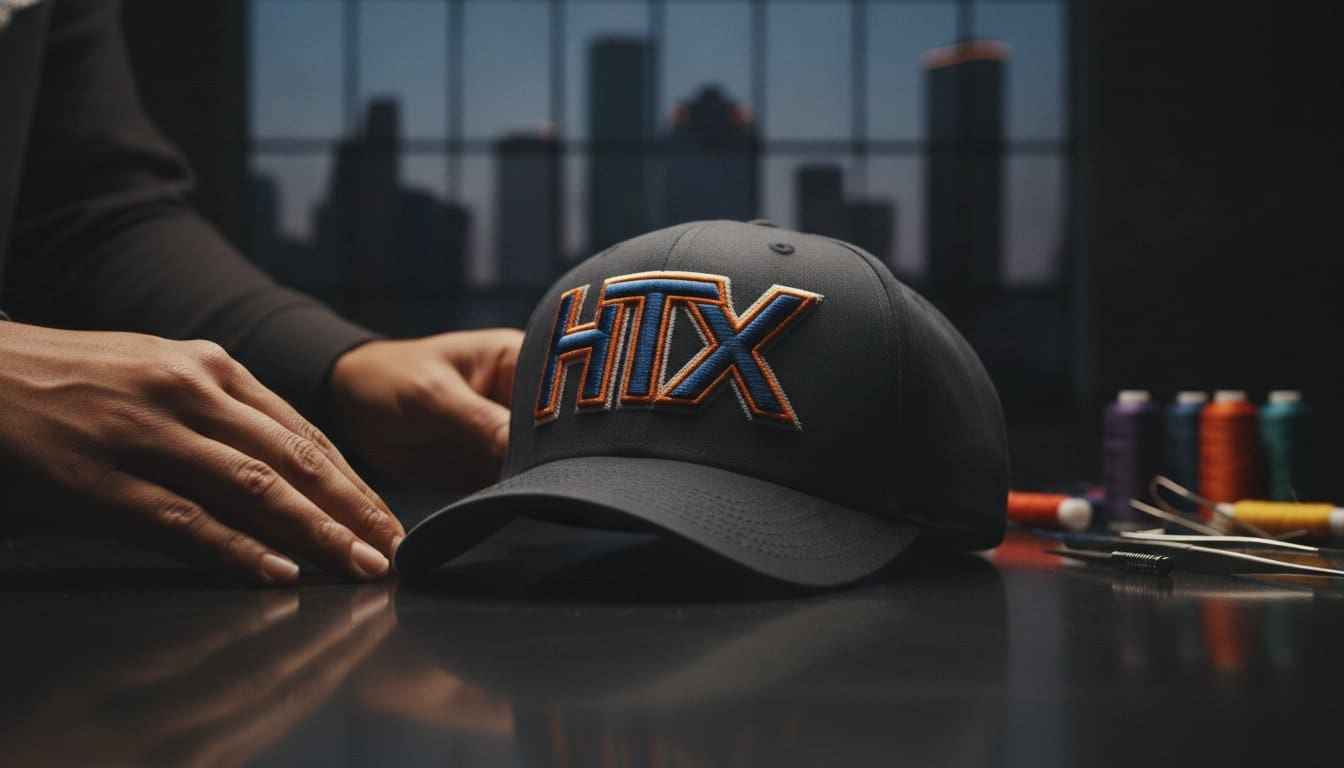
3D Puff Embroidery Houston: The Ultimate Guide to High-Dimension Custom Designs
Flat embroidery is holding your brand back. If you’ve ever held a finished hat and felt that familiar disappointment, that sense that the logo looks printed-on rather than crafted, you already know the problem. Standard embroidery, no matter how precise, sits flush against the fabric and loses the visual weight your design deserves. The good news? That’s exactly the gap that 3D puff embroidery in Houston is built to fill.
You’re right to want more from your custom apparel. A logo that commands attention, that you can actually feel when you run your thumb across it, tells a completely different story than one that blends into the weave. It signals quality before a single word is spoken.
This guide will walk you through everything you need to know about 3D puff embroidery: how the technique works, which designs translate best to the raised format, what durability really looks like on everyday garments, and how a boutique Houston partner like Embroidery By Shotzy handles the technical digitizing work that makes it all possible. By the end, you’ll know exactly what to expect and how to bring your vision to life with the depth and dimension your brand deserves.
Key Takeaways
- 3D puff embroidery uses a foam insert beneath the stitches to create a raised, tactile effect that gives logos the visual weight and professional presence that flat embroidery simply cannot match.
- Not every design translates cleanly to the raised format — you’ll discover which shapes, line thicknesses, and corner styles work best before you commit to production.
- Choosing 3D puff embroidery in Houston through a boutique specialist like Embroidery By Shotzy means your digitizing is handled by an expert who understands how to adapt your artwork for the higher stitch density the technique demands.
- 3D puff carries a premium over flat embroidery, but a smart design strategy — using raised stitching for your primary logo and flat embroidery for supporting text — can help you maximize impact while managing costs.
- Working with a local Houston artisan rather than an online factory gives you a collaborative partner invested in getting every detail right, from foam selection to final stitch quality.
3D Puff Embroidery: Houston’s Premium Choice
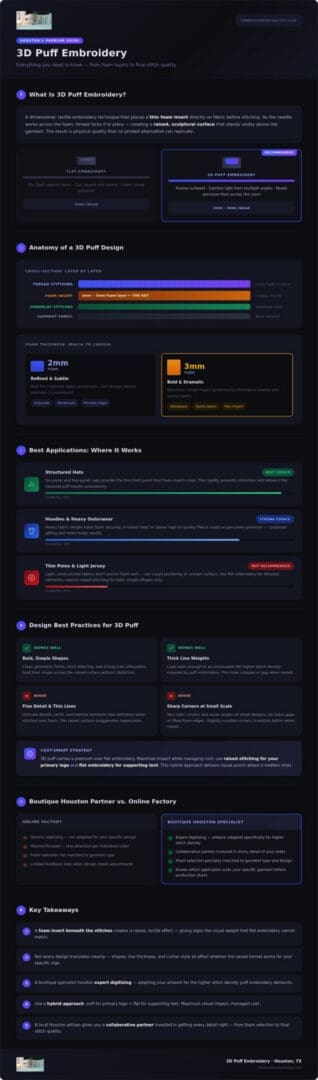
At its core, 3D puff embroidery is exactly what the name promises: a dimensional, tactile technique that uses a thin foam insert placed directly on the fabric before stitching. As the needle works across that foam layer, the thread locks it in place and creates a raised surface that stands visibly above the garment. The result isn’t just visual. Run your thumb across a well-executed puff logo and you feel the craft behind it. That physical quality is something no printed alternative can replicate, and it’s precisely why 3D puff embroidery in Houston has become the standard for brands that want their apparel to communicate quality before anyone reads a single word.
The difference from standard flat embroidery comes down to presence. Flat stitching lies flush against the fabric and, on textured materials like structured hats, can actually recede into the weave. Puff embroidery pushes outward. It catches light from multiple angles, creates shadow and depth, and gives even a simple wordmark or icon a sculptural weight that reads as premium from across the room. If you’ve ever picked up a retail cap from a major brand and noticed how the logo seems to jump off the front panel, you’ve already seen what foam-backed stitching can do.
The Rise of 3D Embroidery in Houston Culture
Houston’s custom apparel culture runs deep. Local sports loyalty, a thriving streetwear scene, and a business community that invests in professional presentation have all pushed demand for headwear and uniforms that look genuinely retail-ready. Boutique brands throughout the city have gravitated toward puff embroidery because it closes the gap between something custom-made and something you’d pull off a shelf at a flagship store. Embroidery techniques and history stretch back centuries, but the dimensional puff format represents one of the craft’s most commercially compelling modern evolutions. For corporate gifting and high-end promotional headwear, that elevated finish signals the kind of attention to detail that reflects well on the organization giving it.
Common Applications: Beyond the Baseball Cap
Structured hats remain the undisputed home of 3D puff embroidery. The firm front panel of a six-panel or five-panel cap provides the stable base the foam insert needs; without that rigidity, the raised design can distort or shift during wear. That structural support is why hats consistently deliver the cleanest puff results.
Hoodies and heavy outerwear are strong secondary candidates. The weight of the fabric holds the foam securely, and a raised chest or sleeve logo on a quality fleece reads as genuinely premium. Lighter fabrics are a different story. Thin polos or unstructured jersey materials don’t anchor the foam well, which can cause puckering or an uneven surface. For those garments, a skilled digitizer will typically recommend flat embroidery for the detailed elements and reserve any raised stitching for bold, simple shapes where the technique can perform at its best.
Knowing which application suits your specific garment is part of what separates a boutique specialist from a high-volume factory. It’s not just about running the design; it’s about understanding where the technique will genuinely shine for your brand.
The Anatomy of a 3D Puff Design: How the Magic Happens
Understanding what actually happens beneath those raised stitches changes the way you look at the finished product. The lift you see isn’t an illusion or a trick of the thread. It’s the result of several technical decisions working in precise coordination, and each one affects the quality of what ends up on your garment.
The Foam Layer: Where the Lift Begins
The foundation of any puff design is a thin sheet of embroidery foam placed directly on the fabric surface before the machine makes a single stitch. This foam is purpose-built for the technique: it compresses under the needle, bonds with the thread, and holds its shape through washing and wear. Foam typically comes in thicknesses ranging from 2mm to 3mm. The difference matters more than it might seem. A 2mm foam produces a refined, subtle elevation that suits corporate logos and wordmarks where precision is paramount. A 3mm foam delivers a bolder, more dramatic lift that streetwear brands and sports teams tend to prefer for maximum visual impact. Choosing the right thickness for your specific design and garment is one of the first decisions a skilled digitizer makes.
Stitch Density and the Capping Technique
Because the thread must fully cover the foam beneath it, 3D puff embroidery requires significantly higher stitch density than flat work. The stitches need to lay tightly enough to conceal every edge of the foam while maintaining enough tension to lock the material firmly in place. Too loose, and the foam peeks through. Too tight, and the design puckers or the needle damages the foam structure.
The capping technique addresses the edges specifically. At the perimeter of each raised element, the digitizer programs the machine to run a tight border stitch that folds the thread over the foam’s cut edges, sealing them cleanly. Without this step, the foam can fray or lift over time, and the finished logo loses that sharp, sculpted silhouette that makes puff embroidery so distinctive. It’s a detail that separates a thoughtfully executed design from one that simply went through the motions.
Consistent machine tension is equally critical throughout this process. Even small fluctuations can cause uneven foam compression, which creates a rippled surface rather than the smooth, uniform dome the technique demands. Commercial embroidery machines running 3D puff work need careful calibration before every production run.
The Critical Role of Custom Digitizing
You can’t run a standard flat embroidery file on a 3D puff project and expect a clean result. The pathing and stitch sequencing are fundamentally different. The machine needs specific instructions for how to approach the foam, how to trap its edges before completing the fill, and in what order to build each element so the foam stays anchored throughout the run. Digitizing for 3D puff embroidery is a specialized technical art form, one that requires both software expertise and an intuitive understanding of how thread, foam, and fabric behave together under the needle. At Embroidery By Shotzy, that digitizing work is handled in-house, which means your artwork gets adapted by someone who understands exactly how the raised and flat elements of your logo need to interact on the final garment. If you’re ready to see what that process looks like for your specific design, reach out to Embroidery By Shotzy to start the conversation.
Foam Colors and Thread Matching
Foam comes in a range of colors, and matching it closely to your thread color isn’t optional. It’s essential. Even with dense stitching, minor gaps between thread rows can expose the foam beneath, and if that foam is a contrasting color, the inconsistency becomes visible. A white foam under a navy thread reads as a flaw; a navy foam disappears entirely. Shotzy selects foam color as part of the overall design consultation, ensuring that the raised elements look seamless whether viewed straight-on or at an angle where the foam’s edge might otherwise catch the light.
3D Puff vs. Flat Embroidery: Which is Right for Your Houston Brand?
Choosing between the two techniques isn’t just an aesthetic decision. It’s a strategic one that touches your budget, your garment selection, and how your logo needs to communicate at a distance. The right answer depends on what your design is actually asking the thread to do.
The Cost Reality of Going Dimensional
3D puff embroidery carries a premium over flat work, and that premium is earned. Higher stitch density means more thread per piece. The foam itself adds material cost. And the digitizing process is more technically involved, requiring a specialist who understands how to sequence the file so the foam stays anchored through every stage of the run. For brands ordering embroidered hats or bags in smaller quantities for a launch event or corporate gifting campaign, that elevated cost per piece is typically easy to justify when the finished product looks genuinely retail-quality. For high-volume bulk orders where subtle, consistent branding matters more than visual drama, the calculus shifts.
One approach that works well for many Houston brands: use 3D puff for your primary logo mark and flat embroidery for any supporting tagline or secondary text beneath it. The raised element commands attention while the flat text stays crisp and legible. You get visual hierarchy and dimensional impact without paying puff rates on every stitch in the design.
When to Choose 3D Puff
Puff embroidery performs at its best when your design gives it room to breathe. It’s the right call when you’re working with:
- Bold logos, block letters, or thick-script wordmarks where clean edges and uniform lift can be maintained across the entire shape
- Single initials or monograms on structured hats, beanies, or heavy canvas bags where the fabric provides the stable base the foam needs
- High-profile events, team uniforms, or corporate gifting where your brand needs to register from across a room before anyone reads the name
Houston’s heat is worth addressing directly here. Quality embroidery foam is designed to hold its shape through repeated washing and sustained wear, including in humid, high-temperature conditions. The thread lock that forms during stitching keeps the foam compressed and stable. A well-executed puff design on a structured hat won’t sag or distort through a Houston summer.
When to Stick with Flat Embroidery
Some designs simply don’t have the physical space to go dimensional. Fine text under roughly a quarter inch in height, intricate crests with tight internal detail, and designs with thin connecting strokes all require flat embroidery to stay legible. The needle can’t build clean foam coverage over elements that narrow without the edges bleeding together.
Lightweight performance polos and thin athletic fabrics are also better served by flat work. Without a firm fabric structure to anchor the foam, puff embroidery on soft or stretchy materials risks puckering, and no amount of skilled digitizing fully overcomes a garment that won’t hold its shape under tension.
The honest answer is that many finished pieces benefit from both techniques working together. Knowing which elements of your specific logo belong in each category is exactly the kind of judgment call that separates boutique 3D puff embroidery in Houston from a factory that runs every file the same way regardless of what the design actually needs.
Designing for Depth: Best Practices for Your 3D Logo
A logo that works beautifully on a business card doesn’t automatically translate to a raised foam surface. The physical demands of 3D puff embroidery impose real constraints on design, and understanding those constraints before you submit your artwork saves you from costly revisions and production delays. Think of it as a different medium entirely, one with its own rules about what shapes, weights, and letterforms can survive the transition from screen to thread.
Line Thickness and Corner Geometry
Minimum line thickness is the first thing a specialist evaluates. Any element thinner than roughly 4mm struggles to hold a clean foam edge. The needle simply can’t build adequate thread coverage over a sliver of foam that narrow, and the result is fraying edges rather than the crisp, sculpted border that makes puff embroidery so visually compelling. Your design needs breathing room, enough physical space for the thread to wrap the foam cleanly on all sides.
Corner shapes matter just as much. Rounded edges and smooth curves are genuinely puff-friendly because the thread can follow the foam’s perimeter without sharp tension changes. Tight right angles and acute points are harder to execute cleanly; the foam compresses unevenly at those corners, which can create a slightly pinched look rather than a smooth dome. If your logo has sharp geometric corners, a small radius added to each point often makes a significant difference in the finished quality.
Font Selection for 3D Execution
Typography choices deserve careful thought. Bold sans-serif fonts with consistent stroke widths are the strongest performers: think block letters, chunky condensed styles, or thick script where every letterform has substantial physical mass. Thin serifs, inline fonts, and typefaces with dramatic thick-to-thin contrast all create problem zones where narrow strokes fall below the minimum workable width. The serifs themselves, those small decorative feet at the base of letterforms, are often too delicate to cap cleanly in foam. A serif font that looks elegant at print scale can read as muddy once it’s raised.
Multi-color puff is possible, but it requires careful planning. Each color field needs its own foam section, which means the digitizer must sequence the stitching so adjacent foam elements don’t interfere with each other during the run. It’s achievable with bold, clearly separated color zones; it becomes problematic when colors meet at thin shared borders.
The ‘Puff-Friendly’ Checklist
- Avoid tiny serifs and complex gradients. Neither translates to foam coverage; gradients in particular require blended stitching that conflicts with the uniform density puff demands.
- Ensure your logo has closed paths. Open or broken outlines make foam capping unpredictable because the digitizer can’t establish a clean perimeter for the thread to follow.
- Submit high-resolution vector files in AI or EPS format. Raster images force the digitizer to redraw your artwork by hand, which introduces interpretation errors that affect the final stitch path.
Collaborating with a Houston Specialist
When you bring your artwork to Embroidery By Shotzy, the first step is a genuine feasibility review, not just a file upload. Every element of your logo gets evaluated for foam viability: stroke weights, corner geometry, internal detail density, and how the design will read at the actual size it’ll be stitched. This is where the hybrid approach earns its place. A logo with a bold central icon and a fine supporting tagline doesn’t have to sacrifice either element; the icon goes dimensional while the text runs flat beneath it, preserving legibility without compromising the visual drama of the raised centerpiece.
Simple adjustments often make the biggest difference. Slightly increasing stroke weights, converting sharp corners to subtle curves, or separating letterforms that sit too close together can transform a design that’s borderline into one that executes cleanly. That kind of collaborative refinement is exactly what separates a boutique approach to 3D puff embroidery in Houston from a factory that runs your file as submitted and ships whatever comes out.
Ready to find out which elements of your logo are puff-ready and which ones need a small adjustment? Share your artwork with Embroidery By Shotzy and get an expert eye on your design before production begins.
Elevate Your Brand with Embroidery By Shotzy’s Houston Craftsmanship
There’s a meaningful difference between a business that processes embroidery orders and one that genuinely cares how your finished product looks in your hands. Embroidery By Shotzy was built around that distinction. Since 2014, the focus has been on boutique-quality craftsmanship over volume, on getting every stitch right rather than getting every order out the door as fast as possible. That philosophy shapes every decision made on your behalf, from foam selection to final quality check.
That’s the gap that separates a local artisan from an online factory. A high-volume operation runs your file as submitted and ships whatever the machine produces. A boutique specialist evaluates your artwork, flags potential issues before production begins, and treats your brand identity with the same care you do. When you’re investing in 3D puff embroidery in Houston, that level of personal accountability isn’t a luxury. It’s the whole point.
Custom Hats: Our Specialty
Headwear is where Embroidery By Shotzy focuses first and sharpest. Structured hats are the ideal canvas for dimensional embroidery, and sourcing the right blank matters as much as the stitching itself. Firm front panels, quality construction, and materials that hold their shape under foam pressure all affect the finished result. That careful blank selection is part of the service, not an afterthought. For clients who want dimensional branding beyond headwear, custom patches offer a compelling 3D alternative that can be applied to bags, jackets, and uniforms with the same raised, tactile presence.
Your Creative Partner in Houston
Clients return to Shotzy for professional uniforms, corporate gifting campaigns, and personal projects alike because the experience feels collaborative rather than transactional. You’re not submitting a ticket into a queue. You’re working with someone invested in the outcome.
One practical advantage worth understanding: logo digitizing is typically a one-time investment. Once your artwork is converted into a production-ready embroidery file, that file lives in your account and can be used across future orders, whether that’s embroidered hats, custom aprons, embroidered bags, or scrubs. Your brand stays consistent across every garment without paying to rebuild the file each time.
Your logo deserves to be seen, felt, and remembered. If you’re ready to find out exactly what’s possible for your specific design and garments, contact Embroidery By Shotzy for a 3D puff quote today and take the first step toward headwear your brand can be proud of.
Your Brand Deserves to Be Felt, Not Just Seen
Every concept covered in this guide points toward the same truth: 3D puff embroidery Houston brands trust isn’t just a production technique. It’s a deliberate choice to communicate quality before a single word is read. You now know how foam thickness shapes the final lift, which design elements translate cleanly to a raised surface, and why the digitizing expertise behind the file matters just as much as the stitching itself.
The difference between a logo that blends into the fabric and one that genuinely commands attention comes down to the hands guiding the process. Embroidery By Shotzy has been that boutique partner since 2014, handling the specialized digitizing work and personal collaboration that high-volume factories simply don’t offer. Your artwork gets a real expert review, not just a file upload.
You’re closer to retail-quality headwear than you might think. Request your custom 3D puff embroidery quote today and find out exactly what’s possible for your brand.
Frequently Asked Questions About 3D Puff Embroidery in Houston
Can any logo be done in 3D puff embroidery?
Not every logo translates cleanly to a raised foam surface. Designs with bold shapes, thick letterforms, and generous spacing between elements are strong candidates. Logos with fine serifs, thin connecting strokes, or intricate internal detail often can’t hold a clean foam edge at those scales. The honest answer is that most logos can be adapted for puff with some targeted adjustments, and a specialist review will tell you exactly which elements are ready and which need a small refinement before production begins.
How much more does 3D puff embroidery cost than flat embroidery?
3D puff embroidery carries a premium over flat work because of the added foam material, higher stitch density, and the more technically involved digitizing process it requires. The exact difference varies depending on design complexity, garment type, and order quantity. Rather than quoting a generic range that may not reflect your specific project, reach out to Embroidery By Shotzy directly for an accurate quote based on your artwork and order details.
Will the 3D puff foam wash out or lose its shape?
Quality embroidery foam is engineered to hold its structure through regular washing and sustained wear. The stitching process locks the foam in place by compressing and encapsulating it under high-density thread, which keeps it stable over time. Turning garments inside out before machine washing and avoiding high-heat dryer cycles will extend the life of any embroidered piece. A well-executed puff design on a structured hat or heavy garment holds its raised profile reliably through everyday use.
What is the minimum order for 3D puff embroidery in Houston?
Minimum order requirements vary by project type and the specific garments involved. Embroidery By Shotzy operates as a boutique specialist rather than a high-volume factory, so the focus is on getting your order right rather than hitting a production floor minimum. Contact Shotzy directly with your project details, including garment type, design, and quantity, and you’ll get a clear answer tailored to what you’re actually trying to accomplish.
Can you do 3D puff on items other than hats?
Yes, though structured hats remain the strongest canvas for the technique. Hoodies, heavy outerwear, embroidered bags, and custom aprons are all solid candidates because the fabric weight anchors the foam securely. Lightweight or stretchy materials are trickier; they don’t hold the foam as firmly, which can cause puckering. For those garments, a hybrid approach using puff for bold primary elements and flat embroidery for finer details typically delivers the best result.
How long does it take to get 3D puff embroidery done at Shotzy’s?
Turnaround depends on several factors: whether your logo requires new digitizing, the complexity of the design, and the current production schedule. New orders that need digitizing take longer than repeat orders using an existing file. Because Embroidery By Shotzy handles digitizing in-house and takes a thorough approach to each project, timelines are discussed upfront so there are no surprises. Reach out early if you’re working toward a specific event date, and the team will be straightforward about what’s achievable.
Is there a specific file type I need to provide for 3D embroidery?
Vector files in AI or EPS format are strongly preferred because they give the digitizer clean, scalable paths to work from. High-resolution PDFs are also workable. Raster images like JPEGs or PNGs can be used as reference, but they require the digitizer to redraw your artwork by hand, which adds time and introduces more room for interpretation. If you’re unsure what format your logo exists in, share what you have with Embroidery By Shotzy and the team will assess what’s needed to move forward.